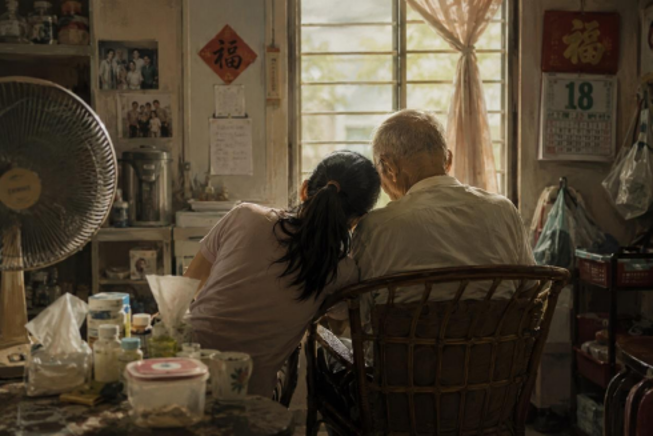
以后谁照顾小妹?Who will look after Little Sister after I’m gone?
The first time we visited Mr Koh’s home, he apologised to us before we even sat down. “很乱,” he murmured.
Very messy.
The flat was small and dim, crowded with the quiet accumulation of daily living. Plastic bags hung from hooks along the wall. Medication packets were scattered among tissue boxes and half-finished cups of coffee stuffed with cigarette butts. Near the television, a standing fan oscillated slowly, its rhythmic motion punctuated by a soft click each time it reached the far left of its arc.
Click.
Pause.
Click.
Mr Koh had been sleeping on a foldable lawn chair when we arrived. A thin towel rested across his chest. When his daughter woke him, he straightened himself almost immediately, looking faintly embarrassed to have been found resting there.
His daughter hurried to clear nearby stools for us to sit.
“Paiseh, paiseh,” she said with a nervous laugh as she sprayed short bursts of air freshener around the room.
Mr Koh watched her quietly the entire time.
Even then, before I had come to understand the family, I noticed how closely he watched her every movement.
By the time we met him, much of the medical work had already begun.
Mr Koh was eighty-seven years old with end-stage renal failure. He had chosen conservative management instead of dialysis. Renal supportive care services were involved. Hospice support had been arranged. Community partners had already stepped in to support them at home.
On paper, much of the support structure was already there.
And yet, each time he left the clinic, I carried with me a vague but persistent sense that something important lay just beyond the edges of our conversations, elusive yet unmistakably there.
At the time, I could not fully explain why.
His daughter accompanied him for almost every appointment.
During consultations, she often sat quietly beside him, tearing tissue paper into smaller and smaller pieces while the team discussed prognosis, medications, and future planning. Sometimes she smiled unexpectedly at remarks no one else reacted to. Other times she seemed to lose track of the conversation halfway through, glancing instinctively toward her father before answering even simple questions.
Whenever she became confused, Mr Koh noticed immediately.
“小妹,” he would say gently.
Little Sister.
The word surfaced so naturally that I barely thought about it at first. It sounded familiar, affectionate and ordinary.
But over time, I began noticing how his entire voice softened whenever he said those words. Not performative tenderness. Just habit.
The kind formed slowly across decades of caring for another person.
One afternoon, during a clinic consultation, someone asked Mr Koh what worried him most. The room grew unusually still afterwards.
Outside the consultation room, trolley wheels rattled faintly along the corridor. His daughter sat beside him, peeling the label off a plastic water bottle with intense concentration.
Mr Koh remained silent for a while.
Then he turned toward her.
“以后谁照顾小妹?”
Who will look after Little Sister after I’m gone?
Nobody spoke immediately after that.
His daughter continued peeling the bottle label, seemingly oblivious that something profound had just been revealed inside the room.
I remember looking down at my notes, though I was no longer really reading them.
Until then, I think I had understood the case mainly through the familiar language of healthcare – frailty, functional decline, caregiver strain, future planning.
But listening to him that afternoon, I began to realise that the centre of his suffering was not only about illness.
It was about leaving behind someone he loved dearly – someone he protected with the fierce devotion of a father caring for a child.
After that conversation, I found myself paying attention differently.
Small moments began standing out more clearly.
The way he reminded her to eat during appointments even when he himself looked exhausted. The way she looked for him instinctively whenever conversations became too complicated. The amount of time it took for them to transfer together from chair to wheelchair during home visits.
Once, during a discussion about respite care in a hospice, his daughter became visibly distressed and repeatedly asked whether someone was trying to separate them.
Before anyone else could respond, Mr Koh reached quietly for her hand.
“It’s okay, 小妹.”
I still remember how quickly she calmed down after that.
Healthcare often teaches us to focus on what can be measured.
Blood results.
Symptoms.
Functional decline.
Disease progression.
These things matter deeply.
But sitting with Mr Koh made me wonder whether suffering sometimes moves subtly through the world – through relationships, routines, fears, and responsibilities that rarely fit neatly inside clinical assessments.
Because while his illness was progressing steadily, another process was unfolding alongside it. A father trying, in the limited time he had left, to make sure his daughter would not be alone. At some point, without anyone explicitly saying so, the centre of care seemed to shift. Not away from Mr Koh – but outward, toward the fragile world orbiting around him. Over the following months, conversations slowly widened beyond medical care alone.
Estranged children whom he had not spoken to in years were mentioned cautiously at first, then more openly. Phone calls were made. Visits gradually resumed.
During one clinic visit, I noticed Mr Koh’s phone resting beside him on the clinic chair. He smiled faintly when it vibrated and asked me when he can leave as he did not want his son to wait too long for him at the pick-up point. Relationships that had once seemed distant and immovable began shifting again in small but meaningful ways.
Nothing about it felt dramatic.
No grand reconciliation.
No sudden transformation.
Just quiet acts of reaching toward one another.
And somehow, that seemed enough.
After Mr Koh died, one of his children told us something that has stayed with me ever since. “He seemed less worried toward the end.”
Less worried.
Not because his illness had improved.
Not because the future had suddenly become certain.
But perhaps because the people he loved had begun finding one another again. There are many clinical details about Mr Koh I no longer remember clearly.
I cannot recall specific blood results or the chronology of appointments. Much of the medical information that once felt urgent has gradually faded with time.
But I still remember the way he said her name.
“小妹.”
Softly.
Lovingly.
Instinctively.
With all the tenderness and responsibility of someone who had spent a lifetime caring for another human being.
For a long time, I thought this story was mainly about illness.
Now, I think it may have been about something else entirely.
About how, even near the end of life, people continue trying to care for one another in the only ways they know how.
And how sometimes, when we ask what matters most, suffering does not disappear – but becomes just a little easier to bear.
Sometimes, when I think about Mr Koh, I still remember the soft clicking sound of the standing fan in his flat.
Click.
Pause.
Click.
And his voice, somewhere beneath it.
“小妹.”
Clinton is a Senior Medical Social Worker at Singapore General Hospital, where he supports patients and families living with chronic kidney disease and serious illness. He is passionate about renal and palliative psychosocial care and believes that listening deeply to patients’ stories is key to understanding what matters most to them. Through both his clinical work and writing, he hopes to foster more compassionate, person-centred care.
The accompanying image was AI-generated using OpenAI’s ChatGPT image generation tool.
Talk back
Thoughts, reactions, a story of your own. We read every comment.