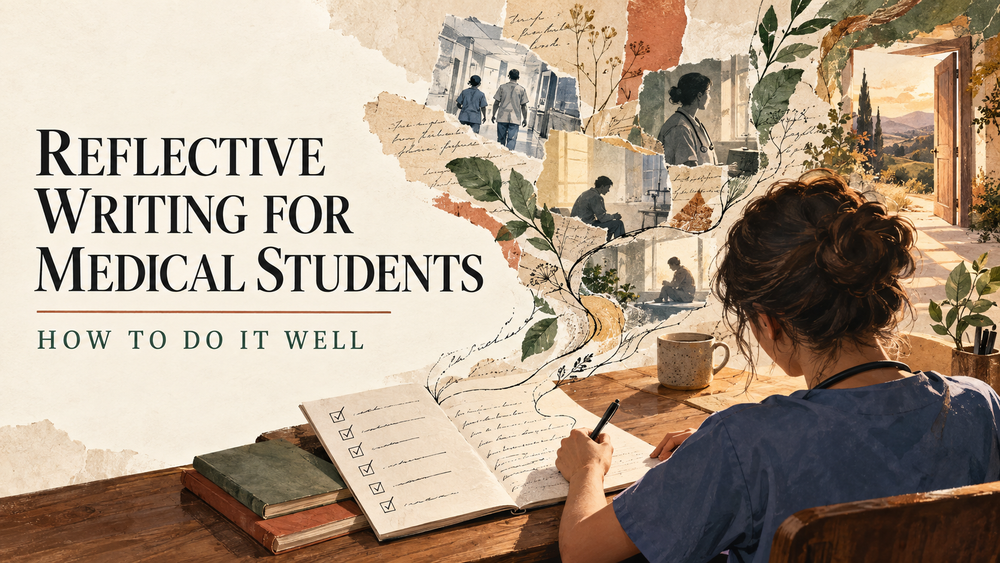
Most medical students learn to write reflection the way they learn to take blood: reluctantly, under supervision, and mainly to get signed off. The portfolio wants a reflective entry, so one gets produced (and increasingly, with the help of AI). It describes an event, names an emotion, cites a model in a bracket, and ends with a resolution to "communicate more effectively in future." It passes. It is also, usually, dead on the page, and everybody involved, the student most of all, knows it.
This guide is about the other kind: reflection that is actually worth writing, and worth reading. The skill is learnable, it transfers directly to the clinical work, and, not incidentally, it is the raw material of the essays and poems that fill a publication like this one.
What reflection is for
The point of reflective writing is not to prove you had feelings (we know you do! Everybody has feelings, even Dr. House). It is to think about experience closely enough that you learn something you did not already know when you sat down. A good reflective piece changes its writer slightly between the first line and the last. A hollow one arrives at its conclusion before it starts, then walks there in a straight line.
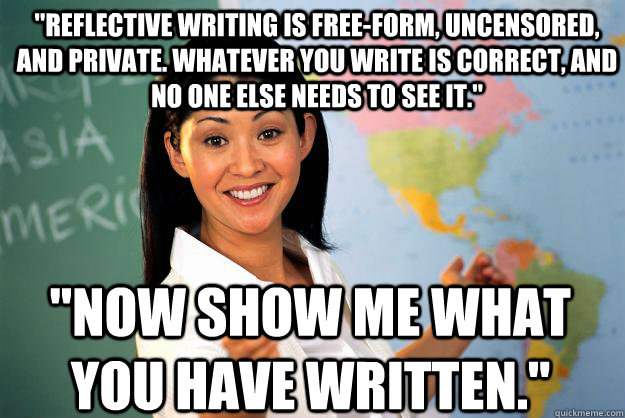
This is why the assessed portfolio so often produces bad reflection. When the reward is a tick, the safest move is to perform insight rather than have it: to reach the tidy lesson fast and defend it. But the tidy lesson is exactly what reflection is meant to complicate. The registrar you found cold may have been three hours into a resuscitation you never saw. The "difficult" patient may have been frightened. Reflection is the act of staying with the event long enough for the second, truer reading to arrive.
The models, and when they help
You have probably been handed at least one reflective model. They are useful scaffolding, especially early on, provided you treat them as a way in rather than a form to fill.
Gibbs' Reflective Cycle (1988) is the one most UK and Singapore curricula lean on. It runs through six stages: description, feelings, evaluation, analysis, conclusion, and an action plan. Its strength is that it forces you past description: most weak reflection never leaves stage one. Its weakness is that the six neat boxes invite six neat paragraphs. Use it to make sure you have done the thinking; don't let its shape become your essay's shape.
Kolb's experiential learning cycle (1984) sits underneath Gibbs and is worth knowing as the theory of why any of this works: concrete experience, reflective observation, abstract conceptualisation, active experimentation. In plain terms: you do something, you think about it, you draw a principle, you try the principle out. It is a good reminder that reflection is only half the loop. The other half is the changed practice.
Driscoll's "What? So what? Now what?" (1994/2007) is the model to reach for when you are short of time or the event is small. Three questions: what happened, why does it matter, what will you do. It is fast, it is honest, and it resists padding. For a brief ward-round moment that stuck with you, it often works better than Gibbs.
Schön's reflection-in-action and reflection-on-action (1983) is less a template than a distinction worth carrying. Reflection-on-action is what you do afterwards, at the desk. Reflection-in-action is the thinking a good clinician does mid-encounter, adjusting as the consultation unfolds. Naming the difference helps you see that the writing you do tonight is practice for the noticing you will do at the bedside tomorrow.
Pick one and let it recede. The model has done its job the moment it gets you writing about what actually happened.
How to write reflection that isn't hollow
Once the scaffolding is up, the difference between a dead entry and a living one comes down to a few habits.
Choose a real moment, small and specific. Not "my palliative care rotation" but the ninety seconds when a patient asked you, not the consultant, whether she was dying, and you did not know what your face was doing. Specificity is the whole game. A named, dated, ninety-second moment carries more truth than a fortnight summarised.
Write the part you would rather leave out. The reason most reflection is boring is that it is careful. The writer manages their own image, reaching for the version where they behaved well or learned gracefully. The interesting material is almost always the thing you flinched from: the irritation you shouldn't have felt, the relief when a patient was discharged to someone else, the mistake nobody noticed. You do not have to publish it. But write it, or the piece will stay safe and safe is dead.
Stay in the not-knowing. Weak reflection resolves. It ends on a lesson learned and a plan made, the bow tied. Strong reflection often ends unresolved, because the honest position is that you still don't know what you should have done. Editors and examiners who actually read for quality can tell the difference between earned uncertainty and evasion. The first is the sound of a mind at work.
Cut the vocabulary of the appraisal form. "Going forward," "areas for development," "consolidate my learning," "holistic patient-centred care." This is the language of the tick-box, and it signals to any reader that no real thinking is happening. Write the way you would explain the event to a friend you respect.
A worked contrast
Here is the difference on the page.
Hollow:
During my surgical placement I encountered a challenging communication scenario with a distressed patient. This made me feel uncomfortable. On reflection, using Gibbs' cycle, I recognise the importance of empathy and active listening. Going forward, I will endeavour to communicate more effectively to deliver holistic patient-centred care.
Alive:
The woman in bed four asked me if she was going to die, and I said "the team will discuss that on the ward round," which was true and also a way of leaving the room. I have thought about that sentence for three weeks. It was correct. It was not an answer to what she asked. I still don't know whether the honest thing was beyond my role, or whether I hid inside my role because the honest thing frightened me.
The second is shorter, names a specific moment, admits the thing the writer would rather not, and refuses the tidy resolution. It would also survive being read by a stranger, which is the real test.
Beyond the portfolio
Reflective writing done well outgrows the assessment it was born in. The habit of paying close attention to clinical moments, and finding language equal to them, is the same habit that produces essays, verse, and the kind of writing HEART exists to publish.
If you have written something in a portfolio that turned out to be more than an exercise, something that surprised you, that you would want a reader to sit with, it may already be a submission. Our writing-prompts guide is a good place to start something new, and In Common, our monthly community series, is designed as a gentle first place to publish: short, themed, and open to students. You do not need to be a polished writer. You need to have paid attention to something real, and to have told the truth about it.
HEART is the narrative medicine and medical humanities publication of the SingHealth Duke-NUS Medical Humanities Institute. We welcome writing from medical and health-professions students.
Talk back
Thoughts, reactions, a story of your own. We read every comment.