This piece is part of In Common, a collaborative writing series where voices from across the healthcare community respond to a single shared word - Threshold
That wobbly threshold. That space in between. Some call it liminal. Others say it is natural.
I felt it with you, Jo, when you informed me that my father was not looking well, that the end was near. Not verbatim - the unspoken, hovering at the tip of your tongue, your sentence lingering without closure. I heard it clearly, my own words filling in the blanks.
Jo. I didn’t know your name until your colleague told us on the day my father would die.
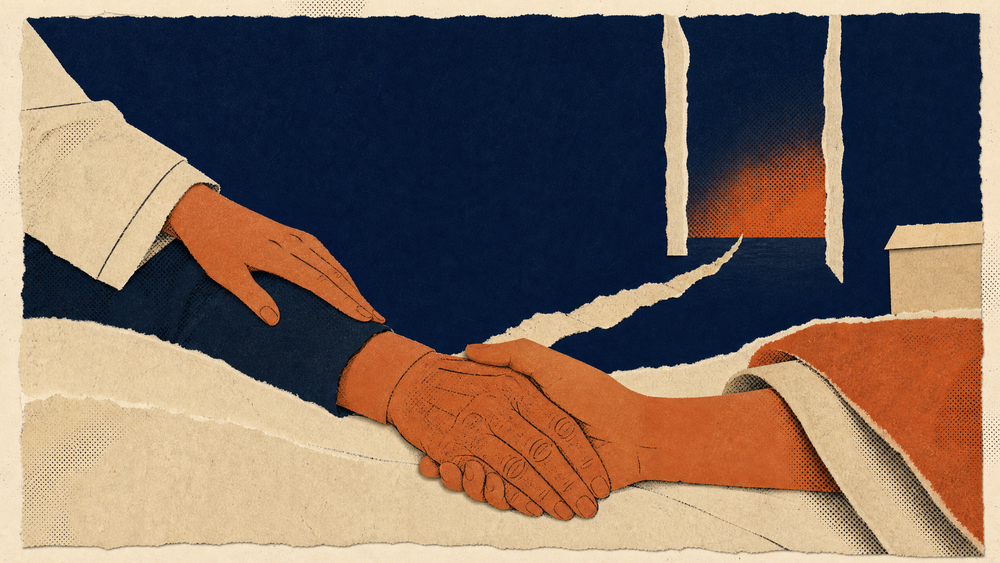
On the penultimate afternoon, you had touched my back to comfort me during the bedside round. By now, you had figured out that my father and I were close.
What remains unspoken is communicated silently, affectively: through gestures, through touch.
I touched you too, breaking barriers when you came bearing bad news. I wanted to let you know that it was all right, that as a graphic medicine researcher I understood the dilemma depicted in All Death Matters. That I, like you, did not want my father to undergo further uncomfortable intrusive procedures.
That I, like you, know that death is inevitable. That we all cross over to that other side where words are no longer necessary.
Touch is essential. There is no more touch after death.
I held my father’s hands, letting him know that he wasn’t alone, keeping them warm because his body was not producing enough heat anymore, communicating presence through squeezes when he no longer had the energy to speak.
Touch humanises, crossing boundaries to bridge the two sides of the threshold.
Your touch caught me by surprise and almost triggered the waterworks.
When I touched your arm, Jo, I wanted you to know: I saw that you felt deeply too, and we could share the burden of a difficult decision together.
KT is a Singaporean disability and cognitive literary scholar, urban explorer and educator on topics of identity and inequity. Currently based in Belgium, they centre their work on strengthening connections between comparative literature, graphic medicine, medical humanities and disability justice through participatory research. The story presented here stems from their experiences at Dover Park Hospice, where their father received palliative care.
Talk back
Thoughts, reactions, a story of your own. We read every comment.