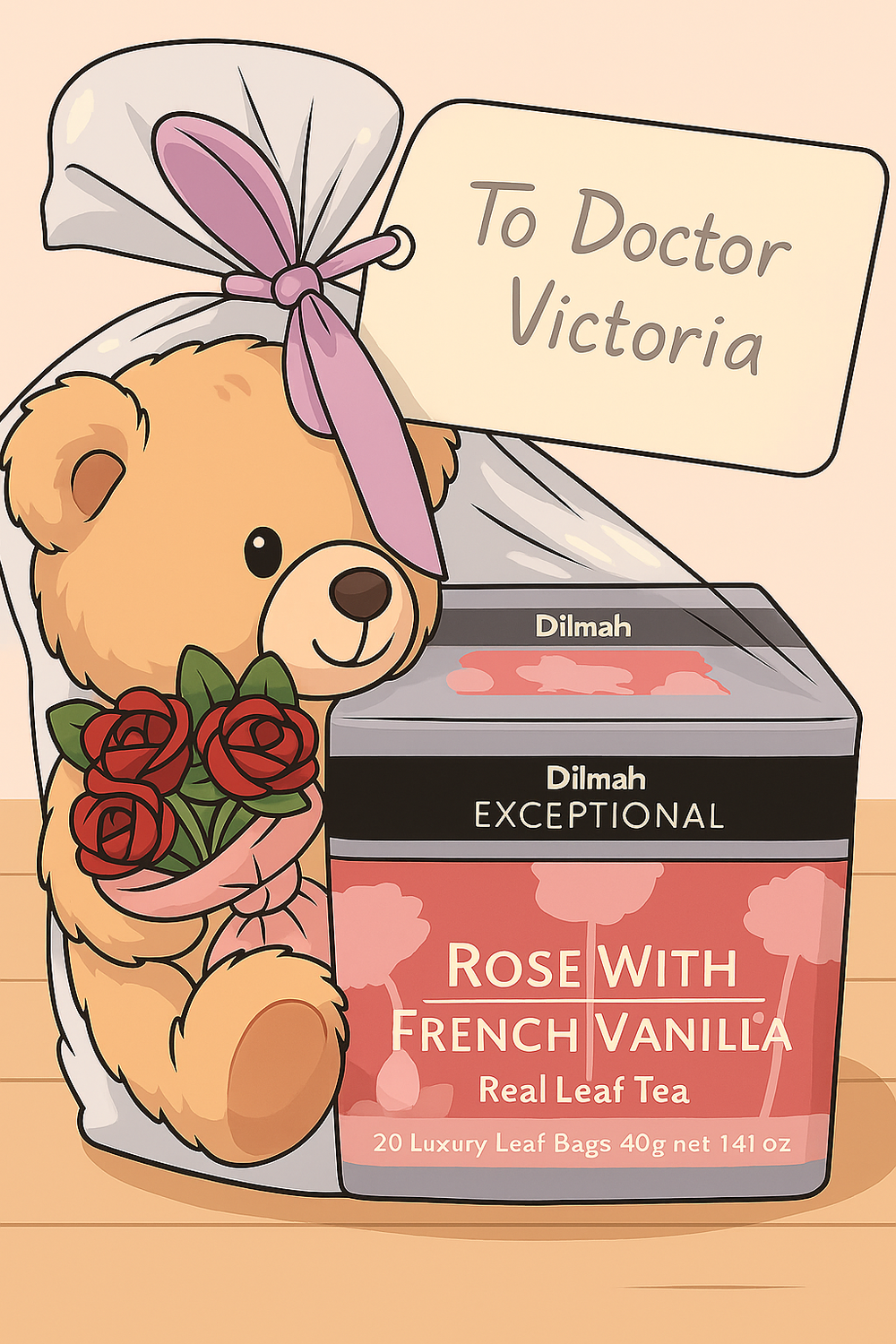
There’s a teddy bear and an unopened box of rose-flavoured tea sitting quietly on my shelf at work.
It was a gift from a patient of mine who has since passed on. We didn’t have the easiest start—she had every reason to be skeptical. She thought I was too young to be of any real help, and I was quietly anxious about her worsening ascites and persistent fever. She would eye me with suspicion when I entered the room, and I would feel myself trying too hard to earn her trust.
Somewhere along the way—though I can’t recall the exact moment—something shifted. A shared laugh? A late-night review during an on-call shift? A silent gesture of understanding? We became, for lack of a better word, friends.
When she was eventually diagnosed with advanced cancer, her care was transitioned to a close colleague. And yet, I found myself returning to see her during my spare moments—half-wondering if I was crossing some invisible line, if I was being “unprofessional” or too sentimental. Perhaps she found me a little strange—this overattached doctor with more emotion than detachment, more heart than protocol.
But she never made me feel that way. Even as her illness progressed, even during the harshest days of palliative treatment, she found the strength to make me a trinket with my name on it. She and her family wrote me a kind, handwritten letter, and gifted me a soft teddy bear and a box of tea—rose-flavoured, because she remembered my caffeine addiction and thought I might need an alternative.
I’ve never opened the tea. I’m not sure I ever will.
In Medicine, we are taught to carry many things:
Stethoscopes, protocols, knowledge.
Important numbers. Ward lists.
A kind of carefully maintained distance.
But we also carry what no one talks about in textbooks.
We carry voices.
Moments.
Regret.
Hope.
We carry the memory of the first time we told someone their loved one had died. The tremble in their voice. The way the room fell quiet. The way we stepped out, pretending we had somewhere else to be, and stood in the corridor staring at the wall for five long minutes.
We carry stories of patients we couldn't save—and some we could, but not completely.
We carry the thank-you notes we’ve folded into our wallets.
The texts we still haven’t deleted.
The faces that come back to us in the shower, the car, the early morning brain fog before clinic.
Sometimes what we carry is visible: a charm on a lanyard, a badge from a conference, a keychain gifted by a child.
Sometimes it's not. Sometimes it’s a quiet ritual before entering a ward, or the way we always take the same route home because it gives us five more minutes of silence.
And sometimes, it’s a box of rose-flavoured tea that never gets brewed.
These objects, gestures, and memories are not just sentimental fluff. They are what help us remain human in a profession that demands resilience, composure, and more emotional containment than most people will ever understand.
In medical training, there’s a hidden curriculum. A lesson passed down between the lines:
Don’t get too close.
Be caring, but not too much.
Don’t let your feelings interfere with your judgment.
But maybe judgment is shaped by feeling.
Maybe the very act of remembering a patient—of being moved by them—is part of what makes us good doctors. Maybe what we carry helps us remember that even if we cannot always heal, we can still witness. We can still honour. We can still care.
So today, I want to ask:
What do you carry?
And what story does it hold?
Is there something on your desk, in your locker, or tucked in the folds of memory—something small, maybe insignificant to someone else—that reminds you of why you do what you do?
If you’re willing, we’d love for you to share it with us. A photo. A sentence. A short story. We’d like to build a collage of these quiet objects and what they represent. Not because we need more sentimentality—but because we need more space to honour the unseen parts of our work.
Because sometimes the softest things—like a teddy bear, a bracelet, or a box of unopened tea—are what remind us who we are, and who we never want to stop being.
With love,
Victoria
on behalf of the HEART team
Talk back
Thoughts, reactions, a story of your own. We read every comment.