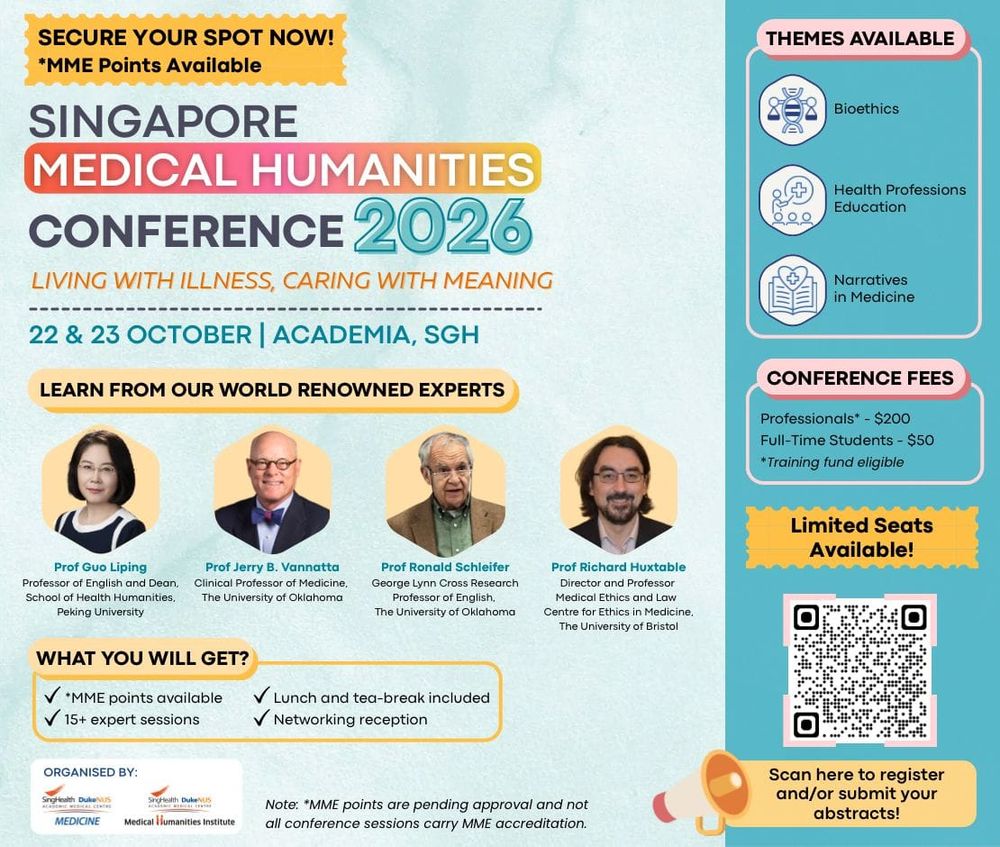
The upcoming Singapore Medical Humanities Conference is in October 2026. It's about what illness actually means — not what the chart says it means. You should come. Here's why.
Once a year, the people who think about medicine and the people who live with it sit in the same room for two days. They eat the same biscuits. They argue about the same things. A consultant and a poet and a medical student listen to each other on the same panel.
If you've ever read something on HEART and thought I want more of this in person — this is the more of this.
What it's about this year
The 2026 theme is the view from outside the clinical lens. From the bed, from the bedside, from the waiting room. From the family dinner that goes quiet because someone has just been told something. From the caregiver who hasn't slept properly in eight months.
Illness isn't just a condition, the organisers write. It's a human experience shaped by relationships, culture, ethics, and meaning. The conference is asking: how can healthcare systems and the people who work inside them respond more thoughtfully to all of that — the moral stuff, the emotional stuff, the relational stuff — instead of only the clinical stuff?
Which is, frankly, the entire reason HEART exists. So we're biased. We're telling you anyway.
The 4th Singapore Medical Humanities Conference brings together clinicians, students, patients, caregivers and humanities scholars around a single question: what does illness look like when you stop treating it only as a clinical condition?
Everything you need to plan a visit is below — dates, fees, speakers, workshops and the registration link.
At a glance
Conference: 4th Singapore Medical Humanities Conference (SMHC 2026) Dates: 22nd and 23rd October
Venue: Academia, Singapore General Hospital
Registration: Register here
Registration fees
| Healthcare & academic professionals | Full-time students | |
|---|---|---|
| Online registration | SGD 200 | SGD 50 |
| Walk-in | SGD 270 | SGD 50 |
Pre-conference workshops are booked separately at SGD 80 each.
Healthcare and academic rates cover doctors, doctors in training, nurses, allied health members, medical social workers, professors, lecturers and community arts and humanities partners. Student rates apply to full-time students at NUS, NTU, NUS-YLL, LKCMedicine, Duke-NUS and elsewhere.
The speakers are a genuinely unusual lineup
Four headliners worth making time for:
Prof Guo Liping — Dean of the School of Health Humanities at Peking University. If you want to know what medical humanities looks like at scale in China, and how an English professor ended up running it, this is your session.
Prof Jerry B. Vannatta (University of Oklahoma) — one of the originators of the narrative medicine programme in American medical education. He's been teaching doctors how to read stories — not metaphorically, literally — for thirty years.
Prof Ronald Schleifer (University of Oklahoma) — Vannatta's long-time collaborator, working on the literary and philosophical end of the same project. The two of them together are worth the registration fee.
Prof Richard Huxtable (University of Bristol) — Director of the Centre for Ethics in Medicine. Writes beautifully about end-of-life decisions, assisted dying, consent, and the places where law, ethics, and bedside reality disagree.
Pre-conference workshops
Three sessions, SGD 80 each, booked separately from the main conference.
- Compassion in Medicine — meeting suffering with kindness, for ourselves and our patients.
- Building New Bridges — connections and innovations in health humanities education in Singapore.
- Holding Space — trauma-informed psychological debriefing in healthcare.
Workshops are the part of any conference that people remember, because thirty people in a room doing something is different from three hundred people listening. If you are attending at all, book one.
You can also submit something
The Call for Abstracts is open. Essays, posters, workshops, art, performances. If you've been sitting on a reflection, a case, a dataset, a poem, a film — this is the place it gets taken seriously. The SMHC is one of the warmer conferences in the region and abstracts from everyone is actively welcomed!
Abstract submission and registration are at the same link →
Who this is really for
If any of these sound like you, come.
- You're a clinician and you've been wanting to find the other clinicians who care about the stuff that doesn't fit on the SOAP note.
- You're a medical student and you're not sure if the humanities part of the curriculum is a real thing people do or a tick box. It's the first one. Come see.
- You're a writer, artist, film-maker, ethicist, social scientist, chaplain, educator, policy person — the SMHC is one of the few places in Singapore where all of those jobs are in the same room.
Register
The 4th Singapore Medical Humanities Conference.
Registration and call for abstracts open now.
→ Register here → Full conference page at SDMHI
If you've been to an SMHC before and want to write something short about what it was like, send it in. We'd love a reader's-eye account for the issue that goes out before the conference. Submissions to narrativesmedicineheart@gmail.com as always.
New to the field, or coming to your first medical humanities conference? Three things to read first:
- Narrative medicine resources — courses, teaching materials, communities and archives
- 40 narrative medicine writing prompts — for the workshop that makes you want to write something
- Where to publish your medical writing — once you have written it
Talk back
Thoughts, reactions, a story of your own. We read every comment.