“It made me more mindful. Whatever case they come to you with (for discussion), they come with their own baggage and that we should be kinder to everyone and give them a chance, because we don’t really know where they are coming from or what baggage the person is carrying and what is going on in that person’s life. Behind the person who is trying to clear the case with me is a whole other human that I don’t know about… We are so busy… We get jaded, doing this year after year, posting after posting, and (this workshop) made me reflect that we don’t know anyone well enough… We may not know them any better because of how short their postings are, but to be kinder to the person who comes to review a case with us.”
One participant shared this with me after a LEGO® Serious Play® (LSP) workshop, reflecting on how the experience had shifted the way they interacted with colleagues at work. Hearing this made my heart feel warm and fuzzy because I truly resonated with it. It also quietened months of self-doubt—about whether this project was worth the time and effort, and whether I, as an introvert, was even capable of facilitating such a workshop. That single reflection was enough. To have influenced even one person’s way of being with others at work reaffirmed everything.
When I first attended A/Prof Jason’s workshop on introduction to Lego® Serious Play® (LSP) during the Singhealth DUKE-NUS Education Conference, I could never have imagined that a year later I would be co-facilitating workshops alongside him. That path began simply by taking an interest, casting aside my doubts and fear of judgment, and choosing to run with it.
The introductory workshop truly piqued my curiosity. It was unlike any facilitation method I had encountered before—it used play. Play is an innate skill; one we all possess and rely on deeply during our formative years. Yet as adults, we seem to abandon it. Working in paediatrics, I found myself wondering: what if we could think a little more like our patients? What if we could speak without fear, or use play to express ideas and emotions that are difficult to put into words?
As an introvert, it took considerable courage to approach A/Prof Jason and ask how I might become a facilitator. I eventually signed up for the four-day LSP facilitator training. During that course, eight people from different professions and parts of the world, some for whom English was not their first language, came together. Through LSP, their stories moved others to tears. I was struck by how effortlessly this method allowed people to share openly and feel deeply.
LEGO® Serious Play® is a facilitation methodology that uses LEGO bricks as a medium for thinking and dialogue. Participants respond to prompts by building models, then take turns sharing the meaning behind their builds. The workshops are conducted in small groups, ensuring that every participant has time to speak and that every perspective is heard. The methodology encourages free thinking, non-judgement, and playful engagement. By externalising thoughts, ideas, and emotions through LEGO as an art medium, participants are prompted toward self-reflection and greater awareness of their values. Thus, creating an inner dialogue that can be shared with others through their models.
Eight months later, I facilitated my first workshop. I struggled. I found it difficult to respond to deeply personal sharing. I felt for the participants, but words did not come easily. My inability to articulate empathy affected the flow of the workshop and, at times, the comfort of the group. Although the feedback was positive, the experience weighed heavily on me. I kept asking myself: How can I do better?
I sought guidance from educators and experienced facilitators, listened to podcasts, and learned, slowly, the language of empathy. With time, practice, and the support of my co-facilitators, A/Prof Jason and Ada, I began to find my footing. I learned how to hold space more comfortably, to help participants feel safe, and to facilitate with greater presence and compassion.
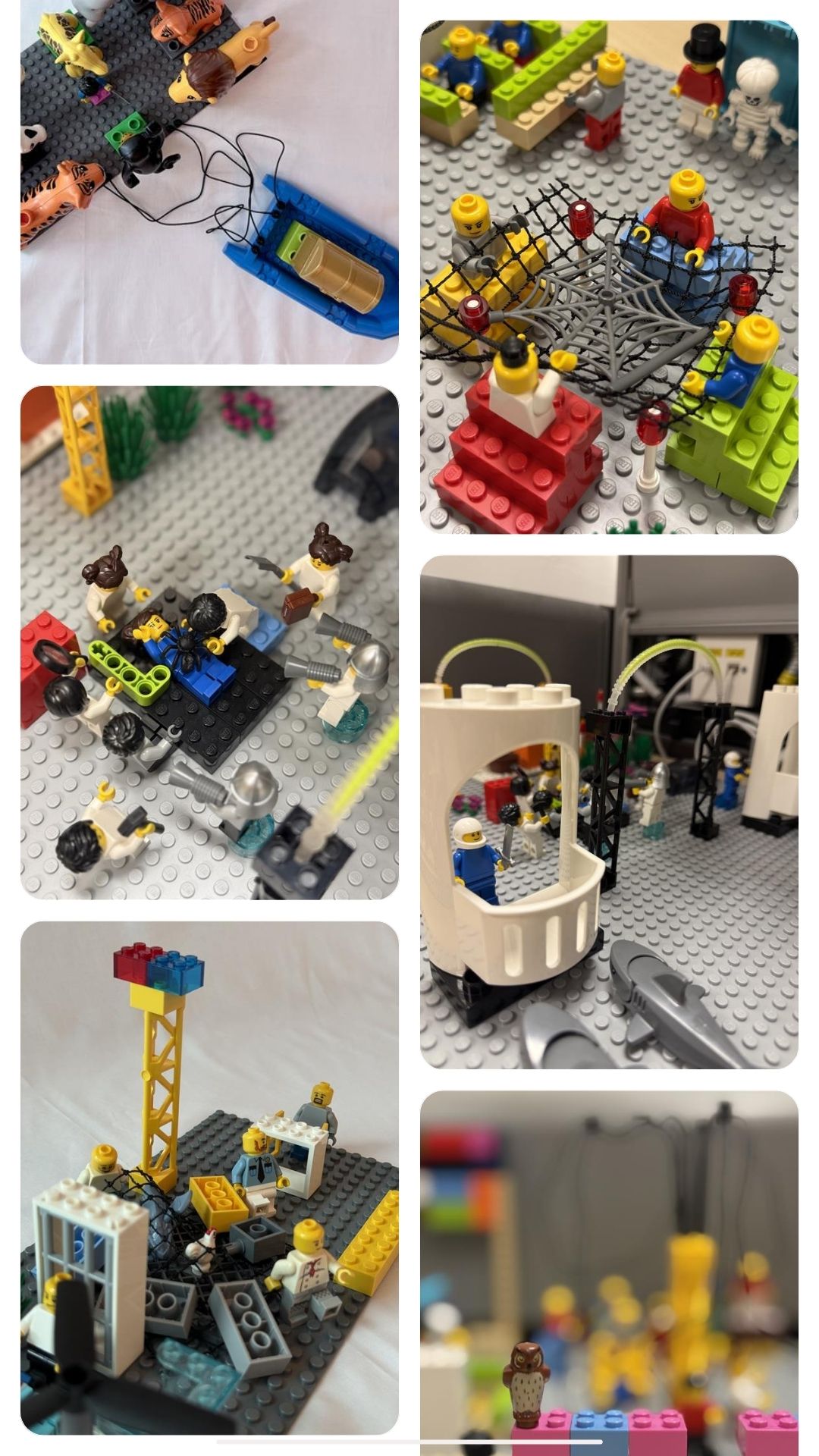
As part of my SingHealth Duke-NUS Paediatric ACP Medical Humanities Grant, we facilitated three LEGO® Serious Play® workshops for colleagues from the Children’s Emergency Department at KK Women’s and Children’s Hospital. Over the course of three months, doctors and nurses of different seniorities came together in small groups to build models about who they are, how they have journeyed through their professional lives, and what belonging in the workplace means to them.
Using LEGO bricks, participants gave shape to experiences that are often hard to put into words. As they shared the stories behind their models, moments of pride, doubt, grief, resilience, and connection emerged naturally. These were not abstract reflections, but deeply personal accounts rooted in everyday clinical work. What stood out most was the sense of safety in the room. People spoke openly, listened attentively, and held space for one another. Tears were shed – not out of distress, but as a sign of trust, relief, and feeling seen.
In medical humanities, we often talk about narratives and meaning-making. LSP gave us a way to witness those processes unfolding in real time; through hands, stories, and shared space. The LEGO models became more than objects; they became vessels for stories that are rarely voiced in the pace and pressure of clinical life. These were not grand narratives, but small, deeply human ones. And they mattered.
It has been a profound honour to hear the stories shared in these workshops. I am deeply grateful to every participant who wore their heart on their sleeve (if only for the duration of the session) and shared so generously. While I set out really hoping that participants would benefit from these workshops, I did not expect to be so personally affected. Months later, the stories still linger with me. More unexpectedly, my own behaviour began to change.
I started to see everyone as a human being with a story; one shaped by challenges overcome, difficult decisions made, and struggles known only to themselves. I began to approach people with a more neutral lens, to care more deeply about colleagues at work and people in life. I found myself less affected by unpleasant interactions and less judgemental toward juniors still learning their way.
Of all the people who attended my workshops over the past three months, I realise now that I was the ultimate beneficiary. Somehow, listening to my colleagues speak about their lives, their struggles and joys, insecurities and sources of comfort, made me more human. Words are not my strongest suit, but I have felt this transformation deeply and perhaps that is the quiet power of this work. Not to change the system overnight, but to gently remind us that behind every role, every case, and every interaction, there is a person. And sometimes, all it takes is a few bricks, a safe space, and the willingness to listen.
On behalf of the Department of Children’s Emergency, we warmly invite you to explore Pieces of Us, a medical humanities exhibition showcasing personal and often unseen stories of identity and belonging shared by healthcare workers and brought to life through the creative medium of LEGO® Serious Play®.
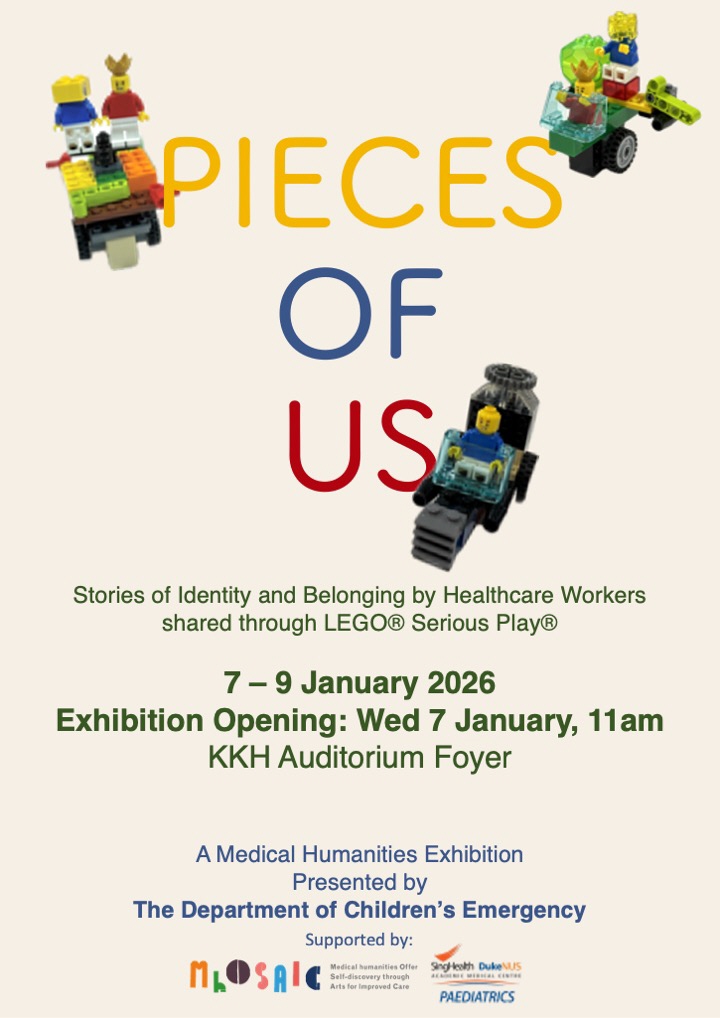
Through a collection of individual LEGO builds, photo stories, and collaborative creations, this exhibition - supported by the SingHealth Duke-NUS Paediatric ACP Medical Humanities Grant - explores how we create meaning, cultivate a sense of belonging, and navigate the emotional rhythms of healthcare.
Exhibition Details
Venue: KKH Auditorium Foyer
Dates: 7 – 9 January 2026
Opening Ceremony: Wednesday 7 January, 11am
Talk back
Thoughts, reactions, a story of your own. We read every comment.