Six months ago, I was at Schiphol Airport, lining up at the immigration counters for the second time in four hours after missing my flight back to the UK.
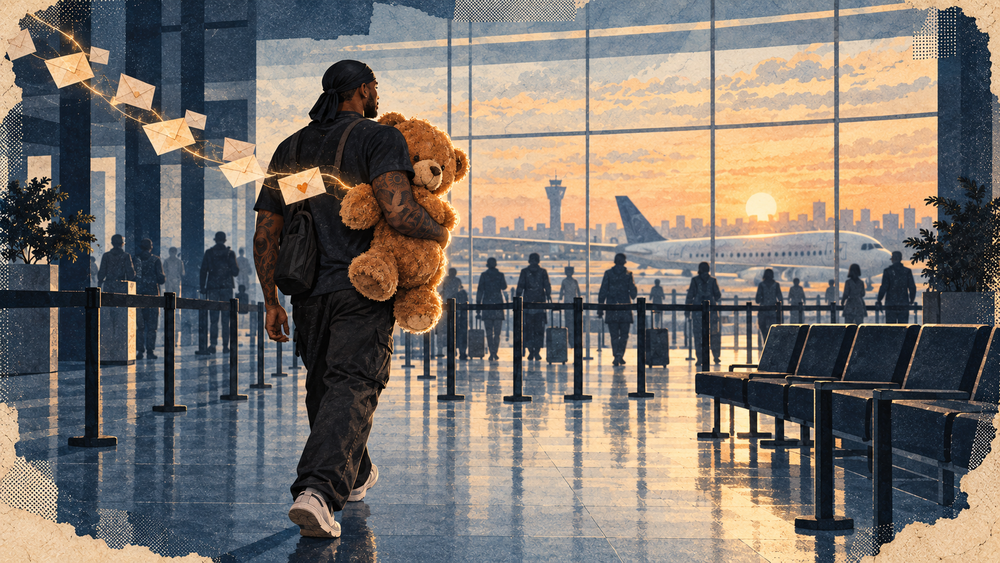
Standing next to me was a tall man. He had a durag on and multiple tattoos rippling in long lines down his arms.
But what caught my attention most was the huge teddy bear he held one-handed, close to his upper body.
I love teddy bears.
It is a childhood love I never quite outgrew. So much so that one of my greatest material wishes in life is not to own a designer handbag, but a Steiff teddy bear.
As both of us cleared immigration, he walked ahead of me.
Without really thinking about it, I hastened my pace until I caught up with him.
“What is the bear’s name?” I asked.
I kept walking as I spoke, taking another couple of steps ahead of him. I fully expected him to dismiss the strange question from a stranger.
Instead, he stopped.
I half turned back towards him.
“I don’t actually know the name,” he deadpanned. “I don’t even know the pronoun. I don’t know if the bear is he, she, it or they.”
I blinked.
Perhaps he saw something on my face because, more quietly, he offered an explanation.
He was scared of flying. His daughter knew this. The teddy bear was hers.
Suddenly, the bear in his arms looked different to me.
His daughter could not board the plane with him. She could not make him less afraid of flying. So, she had given him something of hers to carry instead. And he carried it.
I never asked how old his daughter was. I never asked where he was flying to. I simply thanked him, turned on my heels and walked on.
When I glanced back a while later, he had vanished from sight. I never saw him again.
But I remembered the bear.
Six months later, I found myself thinking about it while reading about the work of the American psychiatrist Jerome Motto.
In the 1960s and 1970s, Motto and his colleagues studied people who had been admitted to hospital because they were depressed or suicidal and who, after discharge, declined further treatment. Some received periodic letters from the research team.
The letters were brief. They offered no treatment and required no reply. They simply expressed concern and communicated that someone remained interested in how the person was getting on.
The letters continued, at decreasing frequency, for five years.
In the original randomized trial, those who received the letters had a significantly lower suicide rate during the first two years than those who received no further contact. Later studies of caring-contact interventions have produced mixed results, and their effect on suicide and self-harm remains uncertain.
I am a psychiatrist, and perhaps I should have been most interested in the statistics.
Instead, I kept thinking about a teddy bear.
A teddy bear and a series of letters are, of course, very different things. One was given by a daughter to a father frightened of flying. The other formed part of an intervention for people at risk of suicide.
Yet both existed because someone had imagined another person’s distress in their absence.
His daughter could not make him less afraid of flying. Motto’s letters could not undo whatever grief, illness or despair had brought their recipients to hospital. Neither gesture promised to fix anything. They simply crossed the distance between two people.
As doctors, and perhaps particularly as psychiatrists, we spend much of our working lives trying to make things better. We prescribe medication. We offer therapy. We make plans and we hope. But there are things we cannot make better, at least not immediately.
I don’t know whether the man carried his daughter’s teddy bear on every flight he took after that one. I don’t know whether other strangers encountered the two of them at other airports. I don’t even know whether he was frightened when his plane eventually left the ground.
I know only that his daughter knew he was scared. She could not take his fear away. So, she gave him her teddy bear.
Months later, reading about letters sent to people simply to tell them that someone was still thinking of them, I understood why I had remembered it.
Perhaps the instinct behind both gestures was not so different after all: I cannot take this away from you. I cannot necessarily make it better. But I thought about you. I care.
And sometimes knowing that could make all the difference in someone’s world, at least for a short while, even if it is only an hour, or a day.
Loshi Rajen is the writing name of Loshini Rajentharan, a Malaysian psychiatrist currently practising in the UK. When not at work, she enjoys people watching as much as she enjoys drawing up words around the people she observes.
Talk back
Thoughts, reactions, a story of your own. We read every comment.