There was a woman who was unmarried and didn’t have many visitors. I was asked to “help her with her pain and swelling.” When I went to visit her, a nurse warned me that she was difficult to engage. I thought, “Of course she’s difficult to engage; it’s an emotional response to a physical symptoms.” When I visited her, she was lying down with her eyes close, Christian worship music, playing softly in the background. I stayed a little while, and she asked me to leave. “Mrs. Annie?” I said. “MISS Annie,” she corrected, eyes still closed.
In the days that followed, our interactions grew from simple exchanges to deeper conversations. I asked if she liked to do anything in her free time (when she was well, of course). She said she loved crafts and showed me photos of her hobbies - cooking and crafting. She used to cook and serve the community at her church. Though she stopped attending, the people still came to pray for her.
On my fourth visit, I found two middle-aged women standing around her. They had some similarities to Miss Annie. I greeted them, and they introduced themselves as her sisters. They had lost contact for years and were looking to reconcile. I had brought origami paper and asked if they would like to make art together while we waited for the patient to wake up. “You make art in the hospital?” they asked. We chatted about my job, shared funny stories, and they told me humourous anecdotes.
Eventually, the patient woke up. “What’s everyone doing here?” she asked in a grumpy voice, unhappy with the commotion. I informed her that her sisters were here to visit her. I expected a reaction, but she did not respond.
She stared silently, her eyes moving from her sisters to me and the origami I was making (with her sisters only watching). “That’s not how she fold a crane,” she commented matter-of-factly. Her sisters shuffled uncomfortably. “You’re right; I don’t know how to fold an origami crane.”
“I would show you, but my fingers are too swollen. Go learn it on YouTube,” she said coldly. Her sisters laughed awkwardly and started to tell me how their sister’s temper had always been “spicy.” They lost their parents young, and it had always been just the three of them. Miss Annie was the youngest and the feistiest.
I saw how Miss Annie was watching me fold the origami crane, aware that my presence helped them continue their small talk. They were talking to each other through me, and I held that space. Fold, flatten, fold, flatten. I did that for the next 30 minutes until Annie asked to rest. The sisters laughed at my origami crane, and we shared glances at the patient, know she would be upset to see my masterpieces.
I met the sisters on each of my subsequent visits to Annie. I would ask a question about their childhood, and they would answer and speak with each other through me. Eventually, the conversations continued after I left and had already started before I arrived. Annie was wincing more each time I saw her, but her smiles grew brighter. She would chucked at her sisters’ banter. Eventually, Annie deteriorated - she was in a slumber most days. “Too much pain, so the doctors let her rest,'“ her sisters said. They didn’t know what to do, so I invited them to make origami with me, and they accepted. They did not do crafts. “Crafe is Annie’s thing,” one of the sisters said. “Let’s do Annie’s thing then, see how it’s like?” I responded.
And craft, they did. We started with origami butterflies - the simplest. They picked papers of various designs, spoke a lot, and cried too. They found symbolism in the butterfly - saying perhaps if Annie flew back to Heaven, she would no longer suffer. We made many butterflies.
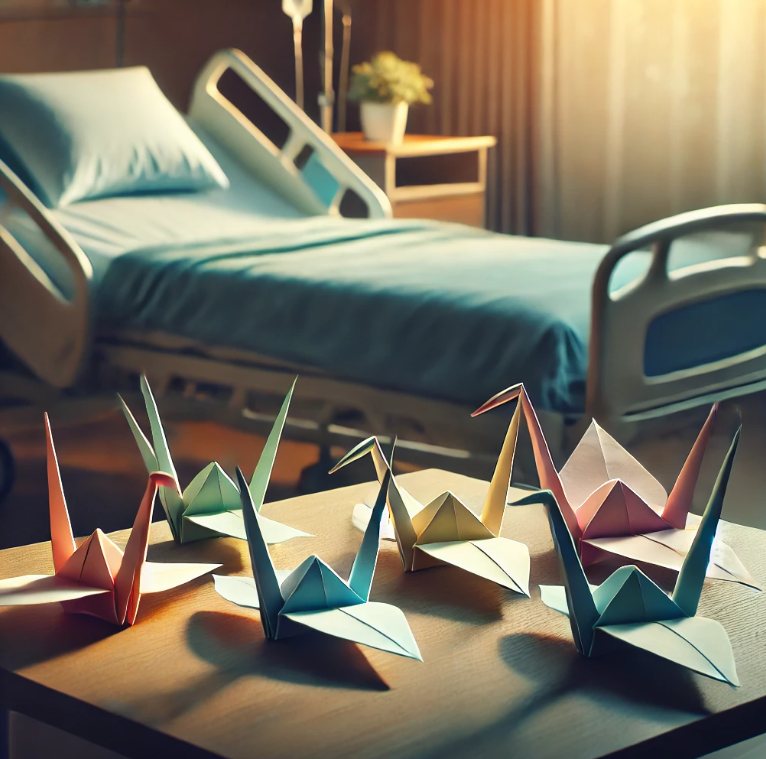
One afternoon, I popped by unexpectedly. The sisters were not there. Miss Annie was awake, looking at the butterflies we had folded. I sat by her and told her stories of how her sisters struggled and learned to fold origami. I relayed the stories they recounted about her. Annie listened intently, smiling weakly at the fond memories. I told her that I believed they didn’t at the start, but they must have learned to like it because they folded so much. Annie said, “These three (butterflies) look like us. This one is big is, this one is second sis, and this shiny one is me.”
I glanced at her gently, nodding in agreement. She eventually passed on that week, with her sisters holding her hands by her side. I was told that her sisters continued to make origami butterflies through her wake and now teach origami at the church. Often, when we meet patients in the hospital, they are mere shadows of who they used to be. The fire and fiestiness may show, but their colour and sparkle rarely do. I do still keep that “lousy” origami crane in my own stash of reflective art. I wonder if Annie did go back to Heaven like the butterly. I wonder about her sisters and how, somehow, the legacy that Annie passed on to them was this priceless legacy of … origami butterflies.
For those who are interested in making an origami crane after this!
Phylaine Toh is an accredited Art Therapist and a part of the faculty at the SingHealth Duke Medical Humanities Institute. In her pieces, she weaves personal narratives to illuminate the often complex intersections of Art Therapy, medical humanities and the people who breathe life into healthcare.
Talk back
Thoughts, reactions, a story of your own. We read every comment.