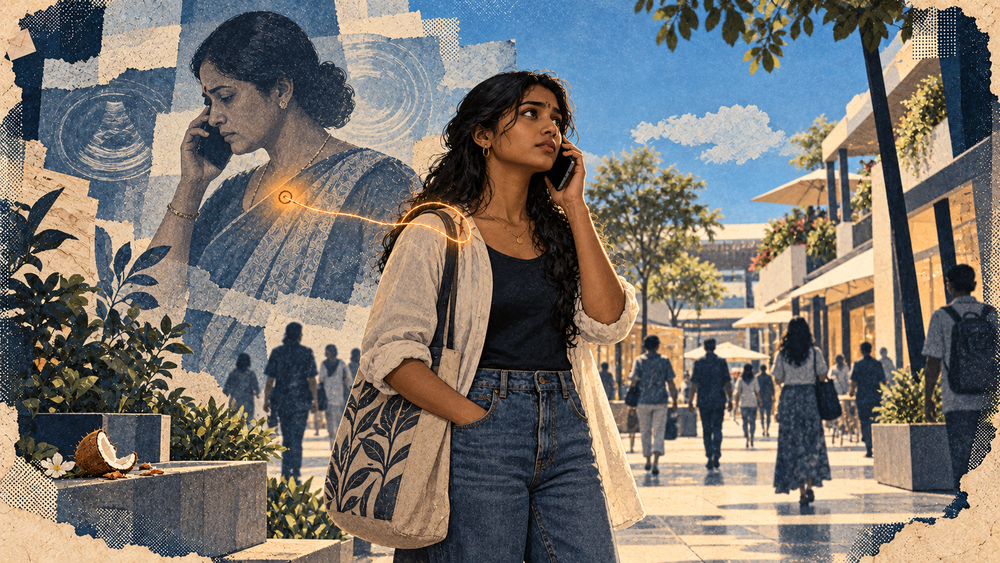
I discovered recently that I am a self-absorbed patient. I could be more charitable towards myself and describe it as the typical arrogance that youth afford us, but even so, I surprised myself.
I try not to define myself as the daughter of a breast cancer survivor, and I try even harder not to define my mother solely as a breast cancer survivor; she and I are both so much more than that disease. However, the implications of it have continued to haunt me since her diagnosis. Every time my breasts have felt tender, every time my period is a little earlier or later or heavier than it’s supposed to be, every time I get sick and feel my lymph nodes a bit swollen, my mind jumps to the worst possible conclusion. Where my peers see normal hormonal fluctuations and bodily reactions, I see disease and serious illness, because the possibility doesn’t feel outlandish to me — even though it probably still should. Seeing sickness up close changes you for life in ways both good and bad.
Three mornings ago, I woke up with a tugging pain under my left arm radiating to my breast. My first thought was a flashback to my mother describing the pain she felt before she was first diagnosed with breast cancer — a tugging pain connecting to her breast. Predictably, I panicked. My next move was to pull my mother into the depths of that panic.
I poked around at the painful area for half an hour until it was throbbing and visibly red, while my mother peppered me with texted questions about what I was feeling and where. Within the next half an hour, I had located the source of the pain — a hard, palpable mass near my left breast — and was on my way to an appointment with a GP at my nearest clinic.
My GP donned her gloves and systematically prodded at my chest until she came to the area of pain. I winced hard as she pressed deep into the fascia under my arm, and I watched her expression shift from polite curiosity to a more real concern as she felt the lump herself. I had been hoping this was another case of hypochondria — I am no stranger to turning innocent tissue near my breasts into imagined pathology — and my heart sank when I realized I was, for once, correct.
She paused while typing up her referral for an ultrasound and MRI to offer me a tissue.
What’s your worst fear? she asked.
I guess that I have breast cancer. It didn’t take me long to answer.
She told me that from what she’d felt of the characteristics of the lump — small, smooth, and mobile — it was unlikely to be “something nasty”. What I didn’t hear was that it was unlikely to be cancerous. I understand why she couldn’t say that, despite me being 24 years old with no BRCA positivity.
Given the strong family history, let’s make sure we rule out everything. That’s why I’ve ordered the scans.
Right. The family history. I’d been so wrapped up in my own woes; I’d forgotten that the precipitating reason I was here and panicking in the first place was because of the family history.
Every thought I’d had while catastrophizing about my lump had been solely about me. Would I have to drop out of med school? Would I have to go through everything that my mother went through? Would I have neutropenia after almost every round of chemo and have to quarantine myself from the outside world? Would I lose my hair, my eyebrows, my eyelashes — should I buzz my hair before treatment starts, like my mother did? Would anyone want to take the risk of marrying someone with a cancer diagnosis?
I stepped out of the clinic into the middle of Queen Street Mall and wandered aimlessly as I fumbled with my phone, trying to call my mother. She finally picked up the third time I called her (what were you doing that was more important than ME, amma?) and listened to her unsuccessfully trying to sound disdainful as she told me that it was probably nothing.
I am 100% confident it’s nothing. Ground yourself in that. They are just being overcautious because of the history. It’s fine if the scans aren’t covered by insurance, just pay for everything.
I stood under the bluest sky I’d seen in weeks with my phone pressed against my ear as the sun burned the streaks of salt on my face, bobbing my head as if my mother could hear my nods through the phone. That was the loneliest I’ve ever felt — so many people bustling around me with shopping bags swinging from their arms experiencing possibly the nicest weather Brisbane had seen in a while — while I was having one of the worst days of my life.
Even after speaking to my mom, it didn’t occur to me to think of my family. Not until I was lying on a clinic bed the next day with an ultrasound probe pressed up against the axillary region of my left breast did, I think about how they must be feeling, especially my mom.
She had been texting me throughout the procedure, with intermittent affirmations poorly masking her own anxiety. One set of my worries had been dispelled by my radiologist, only to be replaced by another. While she didn’t seem too concerned about the multiple enlarged lymph nodes on my left side, my ultrasound technician had marked a prominent duct in my right breast, which my radiologist believed was either a fibroadenoma or a papilloma.
Anecdotally, I’ve noticed that these seem to be more common in Asian women. And South Asian women, she amended.
I had asked her, on my mother’s instructions, if I would still need the MRI that was scheduled for the following day. If it had been just a matter of my lymph nodes, she would not have felt it necessary; however, given the new finding on the right side, and of course the strong family history, she felt it wise to rule out anything precancerous by proceeding with the MRI. She also prescribed a yearly ultrasound going forward to monitor the duct.
Despite the reassurance that there was likely nothing wrong, I felt a new, unwelcome weight settle onto my chest. I had come in concerned about the lump on my left side and was walking out with a discovery on my right side and a mandate for lifelong monitoring. Even in full-blown catastrophizing mode, I hadn’t stopped to consider that I’d be starting yearly scans about ten years earlier than I was meant to. I hadn’t counted on having to carry this new burden. And how was I to carry it without internalizing the fear wrapped up in it? I wondered how many more times I would walk into an exam room, hear given the strong family history, and walk out with a new finding and a new yearly maintenance mandate. Perhaps as long as I live?
I already knew that I view my body and my health differently than most of my peers do, but now I was being forced to treat it differently, too. That still isn’t sitting well with me.
That was when I started thinking about my mom and her journey over the last seven years. While I am not so self-possessed as to assume that her first thought during the lengthy path towards diagnosis was my brother or I, I know we were in the top three. I’m not sure anyone other than myself was even in my top 10.
I realize now that that’s because I have no one depending on me. If something terrible were to happen to me, sure, people would be sad and people would be hurt — but life would go on. At this point in my journey, no one is depending on me the way that a child depends on their mother. I’ve spent the last three days locked in a power struggle with my mortality, and it’s both comforting and jarring to think that the impact my absence would have isn’t necessarily life-altering.
I wonder how much heavier the fear and the process must feel when you know that there are others depending on you that stand to lose along with you. I wonder how it feels to know that they carry your fear with them, and that they’ll carry it after you, too.
It’s easy to ascribe meaning to the pain given all that you have lived through. But, try to shake off that feeling that it is cancer. Don’t convince yourself of what it should not be. Please don’t live in expectation/fear of getting cancer. It’s not a good place to be. Live happy, choose healthy.
I realized upon reading that message from my mom that my fear wasn’t as simple as just being scared of cancer. I had internalized my mother’s experience and was acutely afraid of living through her experience myself.
I called my mom again after my ultrasound and relayed everything that I could remember of what my radiologist told me. Despite me being the medical student, my mother was much more adept at deciphering my radiologist’s meaning — nothing beats lived experience, I guess.
Ok, good. I’m glad everything is just precautionary. Appa broke a coconut for you today morning and has prayed that everything turns out fine, so don’t worry about it. Okay, finally I can sleep now — nethu raathri full-ah thookam eh varale (I couldn’t sleep at all last night).
Despite all of her “100% certainty that it’s nothing at all”, there it was; my mother was as paralyzed by fear as I was, if not more. In that moment, I wondered what it must have been like for my mother on the other side of the phone to fear having to watch her daughter endure everything that she did. To carry the burden of knowing that her diagnosis became the family history that was the precipitating cause of my panic.
I think for a long time now, I’ve carried a quiet resentment towards the fact that I’ve had to worry about signs and symptoms that would appear innocuous to others without family history. I didn’t inherit disease genetically. Neither my mom nor I are positive for BRCA — her diagnosis was a freak event of the universe’s making. But I fear that I have inherited it emotionally, and now that I know that I have to figure out how to carry it differently; without hypervigilance, overbearing fear, or a constant inward tussle with mortality.
While I wait for a definitive report of my ultrasound and MRI, albeit much more at peace, I’ve come to realize that I’m not self-absorbed — I was terrified, and I was terrified because from the first moment, I wasn’t seeing myself. I was a 17-year-old seeing my mother go through all that she did all over again.
My mother is an exceptionally positive and rooted person, and she has long since moved past her diagnosis. Perhaps that also comes with the security that both of her children are now adults and on track for successful lives. However, her diagnosis has changed me in ways that I am only beginning to discover as I move through adulthood and womanhood. Perhaps that’s how we differ; surviving an illness means you eventually get to transcend it, to move beyond it. Loving someone that survived an illness means learning to live with what remains.
Perhaps that is the other part of my inheritance from my mother’s illness. Not the fear and the vigilance, but the responsibility to decide how I want to live my life despite the family history — whether caution will be my quiet companion through life, or whether fear will be my constant shadow.
Anaka is a first-year medical student at the University of Queensland, and an aspiring novelist. She hopes to weave her passions for public health and precision medicine with storytelling as a future OBGYN physician in the future, using narrative to bridge the distance between people and practice – and to illuminate the shared humanity at the heart of medicine.
Talk back
Thoughts, reactions, a story of your own. We read every comment.