If you think about the Paediatric Emergency Department (ED), what word would you use to describe its environment? The ED is unfortunately often linked to descriptions such as “fast-paced”, “intense”, “stressful” and “anxiety-inducing”.
The Paediatric ED has been a second home to me over the last 10 years. This is the place where I have been working, learning and growing alongside fellow senior and junior colleagues, nurses, allied health professionals; many of whom have worked in the department much longer than I have. Honestly, the pressure from facing the ‘overstimulation’ of noise, pace, attention and multi-tasking during every clinical shift does not get any easier over the years. We somehow, developed ways to cope with such situations. One might wonder, in a fast-paced workplace environment where healthcare staff are often exposed to verbal abuse as well, how do we find the essence of “human-ness” and connection?
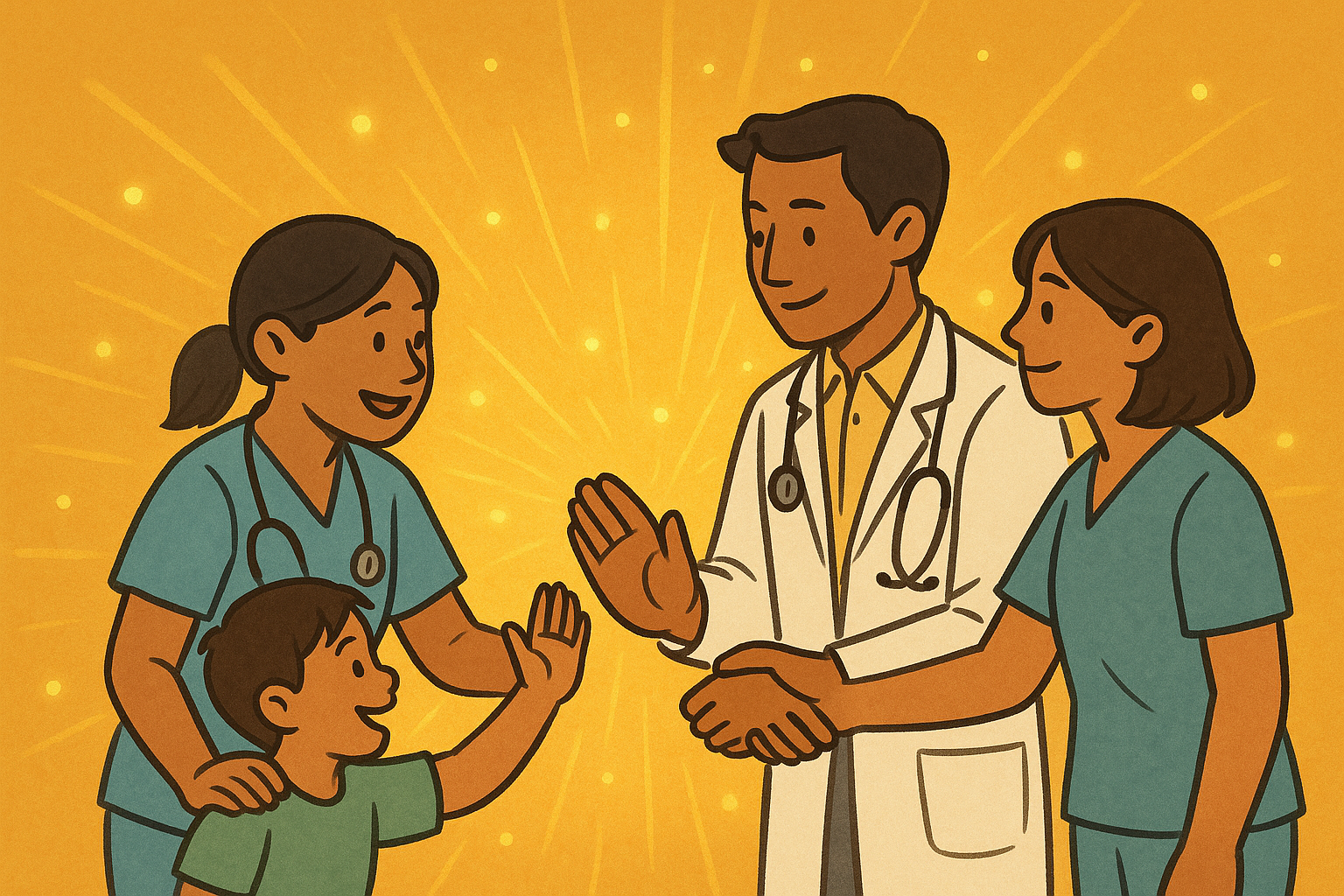
“Noticing the glimmers along the path I walk and learning to spread those glimmers.”
It is undoubtedly hard to find courage and hope especially when things get rough. As healthcare staff, this ‘toughness’ occurs on an almost daily basis; carried within our clinical commitments, intertwined with our personal lives. Over the years, I have learnt to manage my expectations and perceptions, about what “a good day” constitutes. A good day is no longer defined by how many things have gone right. It is redefined by the glimmers, in spite of the toughest or darkest days.
If we look up the dictionary, ‘glimmer’ means shining faintly with a wavering light. Glimmers may be faint, but accumulated, they may actually point us towards the sun. Noticing these glimmers has helped me realise that there is meaning and purpose much larger than that of my own. These glimmers have given me immeasurable strength, and they can be found in our everyday lives within the workplace as well, in the smallest corners.
What constitutes some of these glimmers? As I walk into the department for a typical clinical shift, amidst the crowded triage, waiting areas and walkway, healthcare staff and colleagues would look up, muster a smile, make eye contact, give a nod, call you by name, and gesture a hand wave. That constitutes a quiet strength and acknowledgement that we are all there for our team, our patients and caregivers. We carry a common, small, yet profound purpose; we simply turn up for that particular shift, no matter how hard it was the day before, with lingering fear of what to expect for another day. Hence, reciprocating every gesture, or acknowledging them, becomes an important thing to me—it is one way of spreading the glimmers and support for each other.
While walking into the office and passing the staff rest area, there is a board with notes: someone wrote, “You are never alone”, and “You are here today, and that matters”. There are also pictures and birthday reminders. Passing by the nursing, administrative and senior colleagues’ tables to reach mine, I cannot help but notice that everyone has got something special on their desk- whether it constitutes a messy desk, a desk with soft toys, tables with family pictures, photos taken with students, colleagues, junior doctors and appreciation cards - all of these represent the glimmers they have in their lives, and often remind me to be grateful of what I have as well. Greeting a colleague who is still in the office late in the evening or night, stopping by to check in on how the juniors are coping or simply asking if they have eaten, have become small doable ways to spread the glimmer. A simple reminder that I see you, through a different lens, as a human, and not just for work. That often builds connection that people would remember.
“In a world where you can be anything, be kind.” - Claire Pooley
We see this phrase often. We may interpret this as an important reminder to be kind to others, but it is just as important to be kind to ourselves. In healthcare, we hold ourselves to very high standards and are often unforgiving of our own mistakes. We have all been there. In the ED, we have the benefit of treating and resuscitating the sickest children, but would often wonder about the course as well as progress of the patients we first treated in the ED. Should something bad happen to the patient, we are often quick to question and even assume that there were possible gaps in our diagnosis or management. Sometimes, background discussions happen and we often hear about this 'feedback' through others. We often worry about the documentation and how this may be interpreted by colleagues from other departments. Many times, with the sheer number of patients and multitasking that is required, we are unable to recheck the documentation in time. The priority is always the patient's survival and safety.
Over the years, it has become an art to learn how to let go. Learning to let go at the end of every ED shift, to not ruminate, to accept that as humans we do still make mistakes and learn from them, and importantly, to forgive ourselves. In that process, lies an important reminder that whenever we have new doctors or nurses or colleagues joining the department, they too, would navigate that same curve, and to use those lessons that impacted us, to change our ways of teaching and interacting. We never really know how much or what someone is going through before they turn up at the ED, and that always reminds me to choose kindness. The same goes for our patients and caregivers. Especially when times are bad, we need to remember not to instantaneously react or reciprocate the emotions of angry, anxious caregivers, because at the bottom of these emotions, lies hidden baggage, worry and fear. We too, need to learn to put our own baggage down, so we can have better capacity to care for people and things that matter.
Our own ‘emotional schoolbag’ needs constant decluttering too.
“The most important things in life are the connections you make with others.” -Tom Ford
In between the noise and chaos within the ED, connections can be found at the small corners…if only we notice them. In the procedure room, staff play videos to entertain a fretful child during procedure; some even attempt to sing or hum along.
At the observation area, staff can be seen clapping and cheering for a child that braves him- or herself through a medication or administration of the metered dose inhaler. Another showers a kid with stickers for being brave during blood taking or cast application.
In the consultation rooms, beyond the symphony of crying, you can also hear a loud “Thank you Doctor!!!”, or “I want a balloon!” (which is a request for the doctor to make a balloon using gloves: it is indeed our most economical way of making balloons for kids in the ED, and it can be personalised with smiley faces too!). In the observation area, another child who is better after treatment, now sits up on the bed, watches cartoons on the TV and starts laughing. The nurse would whisper to the doctor, “Oh look…he’s better already.” The parents would nod in agreement, acknowledging the whispered chatter between the healthcare staff.
When the fast pace catches up on us, these are often the forgotten connections. As ED physicians, we too often wonder, what happened to the patient I admitted? Is he or she going to be, okay? Many times, our ‘follow-up’ means following-up the progress of the patient via medical notes. A few shifts ago, I attended a patient in resuscitation. I saw her at the first visit, spoke to the parents, admitted her, and unfortunately the child was diagnosed with cancer. She was back this time with a fever after her chemotherapy. When the resuscitation door opened and the mother saw me, before I could say anything, she said “Oh doctor, it’s you. It’s good to see you.” I knelt next to the little girl, could not help but to notice how frail and pale she looked now. Her mother looked at me and teared up. I wanted to, as well. I sent them off, and her mother shook my hand before she left. A strong, quiet grip. That reminded me that, while, as ED staff, we may not be able to complete the treatment and follow-up with our patients, we are indeed important points along their journey, and their very first point of contact. We initiate the connection, and our patients do remember this connection for a long while.
It is very true, that as Edward Livingston Trudeau said, “To cure sometimes, to relieve often, to comfort always.” Over the years, communication and connection with patients, trainees and colleagues meant not only wearing the hat of a doctor, but also the hats of a mother, daughter, friend and sister as well. Our patients, caregivers, trainees and colleagues are also humans in need of assurance, guidance and direction.
“Love recognizes no barriers.” – Maya Angelou
Humanness and love, are all around us. We only need to open our eyes to see them, and open our hearts to receive and to give them in return. In an ever-challenging workplace environment like the ED, besides resilience, teamwork, effective multitasking, quick thinking and decision making, it is also a place laden with opportunities to build connections and spread glimmer. We meet patients and caregivers when they are the most vulnerable, and our staff also require more support and encouragement than ever to thrive in this environment. One of the most important things that sustain us, which is a basic, yet often undermined, is connection. This gift can be found within all of us, and it recognises no barriers. The only barrier is the wall we have built for ourselves throughout the years. Perhaps it is time, to slowly, break down those walls, and to reconnect with the humanness within all of us.
Su Ann is a Staff Physician in the Children’s Emergency department, KKH. She is passionate about education and teaches healthcare staff from all walks of life, from doctors, to medical students, nurses and allied health professionals. She is a mother to 3 daughters, and loves cooking, reading, singing and currently, rekindling her love for writing, as she navigates the love-hate relationship of her thesis writing in the last league of her Masters in Medical education journey.
Talk back
Thoughts, reactions, a story of your own. We read every comment.