The sun is a disorienting halo, the skies are bluer than most days in July, and 103 year old Mr. H won’t see it. According to his helper, he will only see the last wisps of amber sunset disappearing into the nighttime when he awakens for just three hours a day. Other times, he is lost to the world in a noiseless slumber.
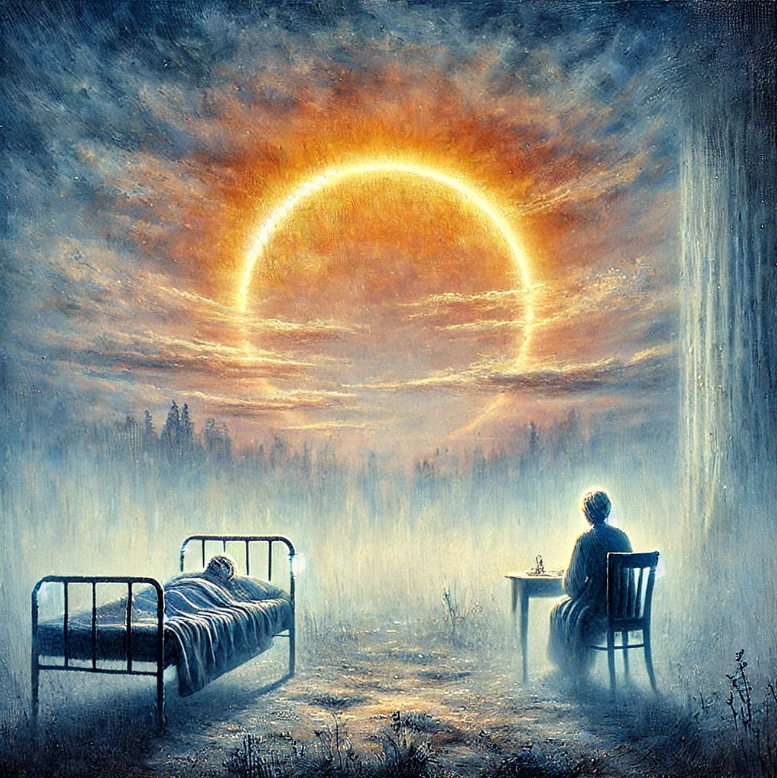
It’s hard to see him like this – silent and unresponsive apart from an occasional moan of pain or a sinister gurgling. His body is an antique mansion in the wind, creaking with every laboured breath. Haunted are his walls by various conditions: chronic kidney disease, respiratory dysfunction, cerebral infarcts, heart failure.
Today, I am a visitor to his home, listening to the grandfather clock ticking irregularly against the tempo of my watch. I feel the vibrational thrills against the walls, the disorganized nature of the beat. The shattered windows of his rooms are scattered with glass opacities, the sounds howling through my stethoscope in rumbling crepitations. His cough brings up nothing but a burnt yellow, like the sunset he misses. I wonder how many more things he misses.
“He’s–his mind’s– just not here anymore,” my classmate states matter-of-factly, then, softer, “It’s terrifying to grow old.” He echoes my sentiments and perhaps we think of the same people – our families – with greying hairs and wrinkling faces, and our own, following the same inevitable path. Most frustrating, perhaps, is that we as future healthcare providers cannot cure it – aging – as if it were a pathological process, and can merely treat its side effects to prolong life while minimizing the pain of living. And throughout all of this, we cannot forget that the patient is a story we can’t fully fathom: who are we to know where he is; where he has been, or what he is left with? We can only see him as he is now, in this moment, in this short wedge of time in his life he may never remember. And then comes the most frightening part–that no matter where he has been, he will always end up here – older, sicker, quieter. And as we age, we too cannot defy a similar reality.
Seeing Mr. H reminds me of life’s inevitable epilogue, when our biological homes crumble into the mere values and legacies we pass along to those we love. In this realization I become disoriented – almost distraught – by the concept of aging. His silent and still demeanour contrasts so greatly against the pace of living in our current youth and course of study.
In learning medicine, I feel the naivety and innocence of time’s passage. I am distracted by Moore and Dalley’s Clinical Anatomy 8th edition and Clinical skills mornings and professional identity and developing passions. Every new year is just another opportunity. Time almost seems bearable if its quicker–the exams will be over, the skills will be acquired, and I will finally have the knowledge to make a difference in a patient’s life. Life is only overwhelming because it’s happening all at once. Yet, somehow, I wouldn’t want it any way, becomes slowing down means stagnancy and stagnancy breeds apathy…or so it’s constantly told at this time of our lives – there is no time to slow down when you are just starting your story, or embrace time’s passage as a positive journey.
Yet time for patients like Mr. H passes differently, I imagine. It is so difficult to slow down and imagine how he lives his time when we are too quick in our own. More than ever as students, there is an abundance of people moving in and out of our lives.
“Then how do you deal with saying so many goodbyes?” I wonder out loud to the consultant conducting the bedside tutorial one afternoon in the geriatrics ward. Curious eyes clouded with cataracts follow us from creaking geriatric chairs. The white haired man with a nasal cannula feebly yanks against his fall restraints. Pained moans drift in and out of restless sleep. If internal medicine is the middle of a story, then geriatrics is surely the epilogue.
“Well, we’ve helped them live a full life, and haven’t they, after all?” the doctor replies, and I face, for the first time, a more hopeful perspective. In his words, there is a confidence that stems from competence–-the unwavering trust in his medical abilities that he has best ensured the highest quality of life for his patients so that they may pass with dignity. More undeniable is his trust that this is a place where life has been fully lived, despite its challenges. And in lives fully lived, there is love.
In particular, aging becomes more than just the individual deterioration of mind and body but a testament to the unyielding will of loved ones as well. Families line up at the elevators every day for a glimpse of the person they knew before the illness, carrying hope that they will be the same after it. Visiting hours bring aromas of home cooking and crayon drawings from kindergarten. There is love, so much of it, radiating from every keepsake from home, every phone call, every minute of time spent caring and appreciating and remembering. These are the moments in medicine that best illustrate the indomitable human spirit as it declares, I am thinking of you, I will slow down my life to your pace when we are together, I will take time out of my life for you.
And so Mr. H’s caretaker comes the next morning with memories of home and porridge.
Aging, then, doesn’t seem so frightening after all, for all of us.
Jacqueline Jin is a second-year medical student at Duke-NUS Medical School in Singapore. She majored in chemistry during her undergraduate studies and has a deep passion for literature and the arts, which she believes are at the core of our humanity. She sees medicine in a similar light, as a way to inspire and connect people across all differences—age, race, religion, or gender. Through her writing and her future medical practice, she hopes to touch hearts and make meaningful connections.
Talk back
Thoughts, reactions, a story of your own. We read every comment.