SGH Office of Well-Being
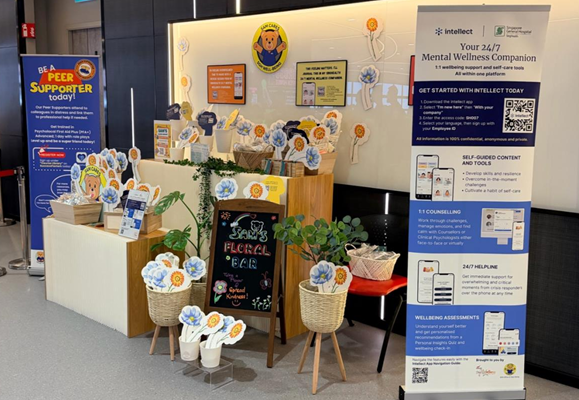
The SGH Office of Well-Being has piloted a new Creative Health–informed approach to staff well-being, a debut initiative which reimagines how staff well-being messages are shared—through a sensory, aesthetically rich experience that invites staff to pause, connect, and feel cared for in the midst of a busy acute hospital (National Centre for Creative Health [NCCH], 2025a).
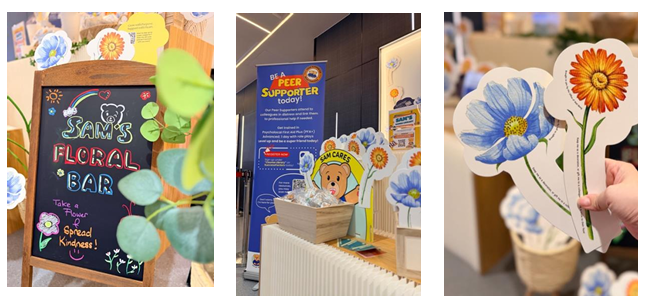
SAM’s Floral Bar, fondly named after SAM, our staff well-being mascot who champions kindness, connection, and care at work, the pop-up floral bar greets staff with high-quality floral artworks symbolising growth, renewal, and mutual care. Each flower holds key well-being information and can be repurposed at a desk or gifted to a colleague, turning a simple information touchpoint into a small act of appreciation and relational well-being. Over time, more floral designs will be introduced so staff can collect and arrange them into their own bouquet, creating a personal, evolving reminder of well-being at work.
The Aesthetic and Humanistic Dimensions of Staff Experience
Through Creative Health and medical humanities—which explore how arts and cultural practices foster reflection, empathy, and resilience among healthcare staff (Shapiro, 2020)—aesthetics refers to the quality of experience: how colour, form, texture, symbolism, and spatial feel shape how people think, feel, and relate (NCCH, 2025a). Evidence shows aesthetically enriched healthcare environments reduce stress and support mood (Fancourt & Finn, 2019), while symbolic engagement like gifting flowers sustains humanistic values that protect professional identity and help prevent burnout in clinical practice (Engel et al., 2023; Green, 2023; SMA, 2021).
Advancing Hospital Staff Well-Being Through Creative Health
As one of Singapore’s largest acute hospitals, the Singapore General Hospital operates in a context of high clinical demand, complex care, and sustained emotional and cognitive load for staff. Alongside structured supports like Employee Assistance Programmes and other well-being initiatives, Creative Health could offer everyday, upstream approaches that are easy to access, non-stigmatising, and embedded into daily work life. International reviews conclude that arts and cultural engagement can support mental health, resilience, and social connection in both patients and health workers (NCCH, 2025a). Locally, tools such as the THRivE Toolkit from the Centre for Music and Health at NUS demonstrate that arts and health programmes can be evaluated for outcomes like mood, social support, and well-being—highly relevant in high-pressure settings (Centre for Music and Health, 2025). Within this broader ecosystem, Creative Health–informed initiatives provide regular, low-barrier opportunities for staff to experience care, agency, and connection in the flow of their workday. They can be understood as a gentle form of preventative social prescribing for staff—inviting simple actions (such as choosing, keeping, or gifting a flower) that support emotional well-being and collegial connection (NCCH, 2025a) This debut initiative from the SGH Office of Well-Being marks an important step in embedding Creative Health within our staff well-being ecosystem, signalling SGH's commitment to evidence-informed, human-centred approaches that help staff feel valued, connected, and able to thrive in an acute care environment (Centre for Music and Health, 2025; NCCH, 2025a).
References
Centre for Music and Health. (2025). Toolkits — THRivE Toolkit: Tools for Health Research and Evaluation in Arts and Heritage. National University of Singapore. https://centreformusicandhealth.sg/toolkits
Engel, T., Gowda, D., Sandhu, J. S., & Banerjee, S. (2023). Art interventions to mitigate burnout in health care professionals: A systematic review. The Permanente Journal, 27, 1–10. https://doi.org/10.7812/TPP/23.018
Fancourt, D., & Finn, S. (2019). What is the evidence on the role of the arts in improving health and well being? A scoping review. World Health Organization Regional Office for Europe. https://www.ncbi.nlm.nih.gov/books/NBK553778/
Green, C. E. (2023). Indoor plants, burnout mitigation and the wellness of healthcare workers. eCommons. https://ecommons.cornell.edu/items/7ed6e7fb-7b37-4419-8d68-071a01200926
National Centre for Creative Health. (2025a). Creative health in practice in acute trusts. https://ncch.org.uk/uploads/Creative-health-in-practice-in-acute-trusts_Resource-Page-Download.pdf
Shapiro, J. (2019, December 16). Using the arts and humanities to build resilience and well-being and reduce burnout in pediatrics health leaders. Harvard Medical School. https://learn.hms.harvard.edu/insights/all-insights/using-arts-and-humanities-build-resilience-and-well being-and-reduce-burnout-pediatrics-health
Singapore Medical Association. (2021). Medical humanities: What is its role in medicine? https://www.sma.org.sg/news/2021/march/medical-humanities-what-is-its-role-in-medicine
Talk back
Thoughts, reactions, a story of your own. We read every comment.