The echo of Mother’s Day still lingers—soft, tender, and complex.
Time rushes forward, but emotions unfold on their own schedule. That’s why we’re sharing this collection now, in the quiet that follows the celebration—when reflection can settle in more gently.
Every mother-child relationship tells its own story: some pages filled with warmth and joy, others marked by longing, silence, or complexity. Most, perhaps, hold a little of everything. Whatever your story, we offer this space to honor it—honestly, and with care.
This collection gathers poems shaped by different moments of inspiration. Some were written during our Poetic Prescriptions workshop, lovingly guided by Jennifer (@soyavocado) and Jamie Zhou, where participants explored the landscapes of familial love through verse. Others were first penned in celebration of International Women’s Day, reflecting on the quiet power that binds generations of women.
You’ll notice that some of the poems in this collection follow a distinctive structure—that’s the DuaTresPentaStep, a poetic form created by Jennifer Leong during Singapore Poetry Writing Month in 2022.
Inspired by the idea of a spiral staircase, each “step” is a self-contained stanza, with poems written in three columns that can be read down or across. The form plays with at least two languages (“Dua” in Malay), three reading paths (“Tres” in Spanish), and five-syllable lines (“Penta” in Greek). There’s rhyme, rhythm, and a delightful flexibility: stanzas can be shuffled and still stand on their own.
It’s multilingual, musical, and made to be read your way. Like relationships themselves, this form carries both structure and surprise, breath and depth.
We share these poems not as polished answers, but as gentle companions—meant to sit beside you, wherever you may be. Whether you're celebrating, grieving, remembering, or simply making space for mixed emotions, may these words meet you with kindness.
Because motherhood—in all its forms—deserves more than a single Sunday in May. It deserves our ongoing attention, our honest stories, and our open hearts.
With tenderness,
The HEART Community
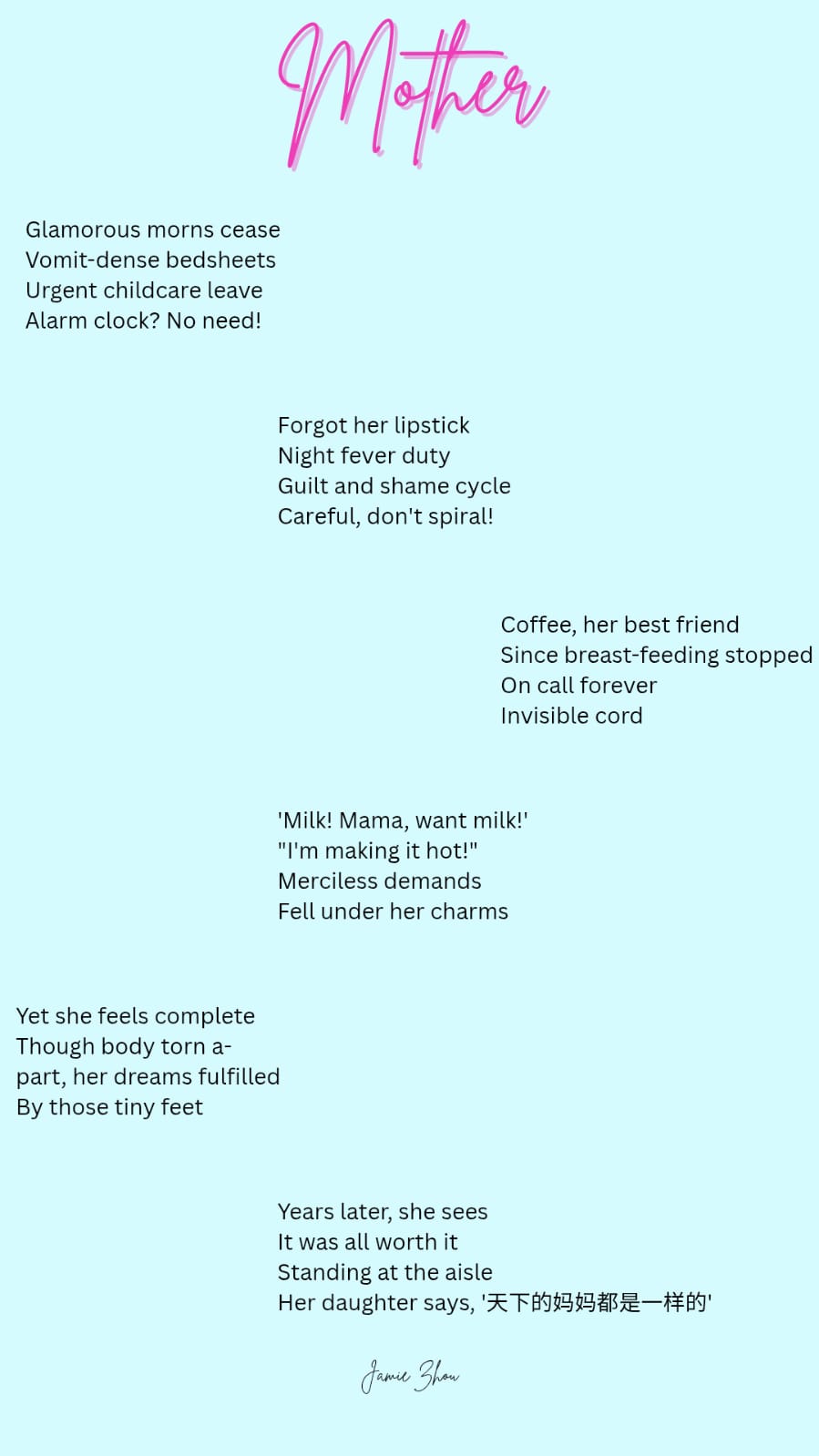
Jamie is a palliative care physician who believes she has the best job in the world — her work entails listening to untold stories of extraordinary lives. She wrote this poem in the style of DuaTresPentaStep.
unwavering
my mother’s mouth is
not medicine at all, but then
her silence smothers
me meek as a mouse
cannot contain her stare down
I blurt I love you
might that be enough
I do not know and yet
her arms are suture
Sudev Suthendran is a senior clinical psychologist at Changi General Hospital. His love for the written word goes way back to his childhood. He is finding his way back amidst the rough and tumble of adulthood, to this first love.
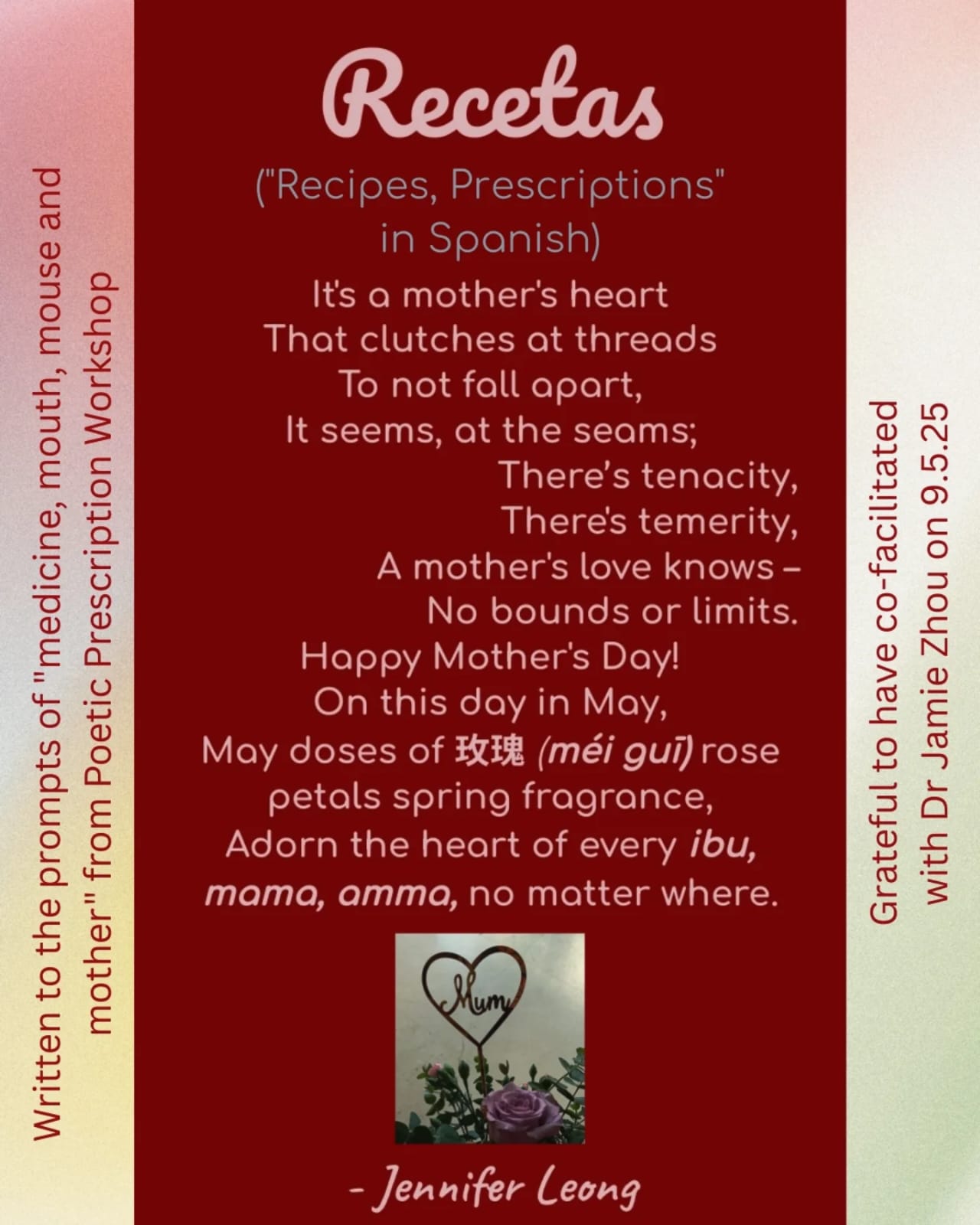
Through her poetry which is often multidirectional and multilingual in line with her "DuaTresPentaStep" poetry form, award winning and Pushcart Prize nominee Jennifer (Soy Avocado) advocates for hope and poetry's accessibility to all.
She is currently working on collaborations that bring diversity together, whether in verse or across art genres.
Rekindling
Does mother know best?
Do all flames turn to embers?
Can’t we coexist?
Written by Dylaine, a research coordinator who's curious about how the humanities can help her to better connect with patients. In this haiku, she bridges this with generational gaps in Asian families, especially how love is expressed.
“Do all flames turn to embers?” This question reflects the transformation from youthful passion to seasoned wisdom. Flames can symbolize the bright, intense energy of young minds — full of curiosity, defiance, and drive. Embers, in contrast, evoke a quieter strength: the slow-burning insight of experience, tempered by time. To “turn to” embers might suggest either becoming wiser with age or seeking guidance from those who’ve endured the burn. Yet, metaphorically, embers can reignite — reminding us that even the most seasoned minds can spark new flames. The cycle between flame and ember isn’t linear; it’s dynamic, and beautifully human.
Wunder* Women
Ms Diana,
The mythological Wonder Woman,
Not quite Anglo or Saxon.
An undocumented migrant in USA,
Hails from the Land of Amazons- Themyscira.
A kick-ass feminist, yet
With quite an impractical costume-
One surely prone, during combat, to wardrobe malfunction.
She flies an invisible jet
Better
She can use her
Lasso of Truth,
To lift the invisible BURKA,
From all her sisters.
To all the Wunder* Women I love :)
Happy Woman’s day
PS: Wunder* in German. = miracle:)
This poem —written by Professor Uma, a neurologist who maps the brain by day and the heart by night—was written for Women’s day and born from witnessing the disturbing rise of misogyny. He is an amateur scribbler guided by Walt Whitman's timeless call to "dismiss whatever insults your own soul, and your very flesh shall be a great poem.”
This Mother’s Day
On this Mother’s Day,
I think of all the simple things
that you’ve done for me.
They are not small things-
Because your eyes and your heart
carry all the big hopes and dreams
you have for me.
I remember,
as a small boy going to school
you would comb my hair neatly
into a “curry pok”.
You always made sure
I had new uniforms, new Bata shoes.
and never second-hand books.
We didn’t have much,
yet my pocket money
was a big slice of the family pot.
Now, time has gone by.
You have grown really old.
I have grown old too.
But somehow, we’ve grown apart.
There are things that we want to say,
but we don’t.
Or couldn’t
But still, I love you, my Mother.
Please let me say it -
“I love you, Mother”
Like I once did, as you tucked in my hair.”
Kok Seng works in SGH and SingHealth Community Hospitals. He writes poems about love, memory, and the quiet corners of life. He posts a new poem every week on Substack. You are previewing his poem about Mother’s Day. This poem and his reflections will be released on his Substack this Saturday.
Talk back
Thoughts, reactions, a story of your own. We read every comment.