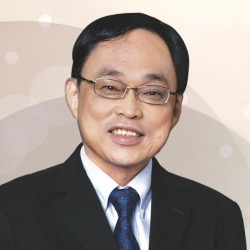
I first met Associate Professor Cheong Pak Yean when I was a medical student, assigned to shadow a GP for my clinical attachment. I was fortunate beyond measure that it was him – the same family doctor my parents had taken me to when I was sick as a teenager. Little did I know then how profoundly this gentle, insightful physician would shape my understanding of what medicine could and should be.
As a student, one of our assignments required following a patient home after their hospital admission. I chose a young boy struggling with Subutex addiction – someone whose life circumstances couldn't have seemed more different from mine. I was young then, carrying the naïveté that my successes were purely the product of my own hard work and determination.
It was Associate Professor Cheong who gently guided me through this experience, introducing me to the concept of narratives in medicine. When I made that home visit, everything changed. I realized that this boy and I weren't so fundamentally different after all. Our divergent paths were largely shaped by the complex interplay of biological, psychological, and social factors – the biopsychosocial model that Professor Cheong so eloquently championed throughout his career.
Many years passed before our paths crossed again. By then, I had become an Associate Consultant, managing most of my minor illnesses independently, but life has a way of humbling us. During a complicated pregnancy requiring regular progesterone injections, I found myself back in his clinic, seeking his help.
What struck me most was that he not only remembered me but recalled the specific essay I had written during my student days. Despite the years that had passed and the countless patients he must have taught, he remembered. We reflected together on the evolution of patient care and medical education – me now more senior but not necessarily wiser, and him still learning, still curious after decades of practice.
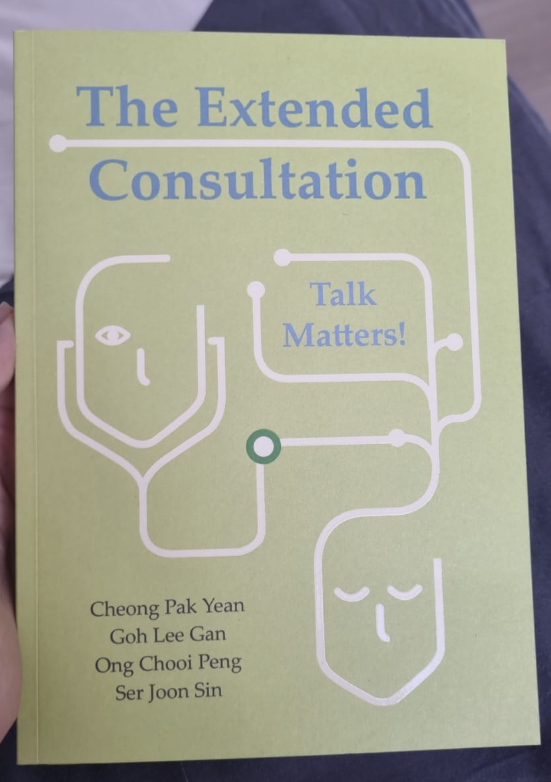
It was during these visits that Associate Professor Cheong shared more about the "Extended Consultation" approach he had pioneered with colleagues. This framework, which extends the traditional consultation to incorporate psychosocial dimensions, remains foundational to my clinical practice today. I treasure my copy of his book on the subject, made all the more special by his kind inscription.
Associate Professor Cheong's impact stretches far beyond his clinical acumen. He was a visionary who understood that healing often happens in the spaces between standard medical protocols – in genuine human connection, in stories shared, in the recognition of each patient's unique narrative. He embodied the Singapore Medical Association's slogan: "For Doctors, For Patients."
As a leader-innovator, teacher-academic, and generalist physician, he helped transform family medicine in Singapore. But for those of us fortunate enough to have been his students, colleagues, or patients, his greatest gift was showing us how to see people in their full humanity – not just as cases to be solved, but as individuals with stories that matter.
My journey from that idealistic medical student to the physician I am today was profoundly shaped by Associate Professor Cheong's example. His legacy lives on in the countless doctors who, inspired by his approach, strive to extend our consultations beyond the physical to embrace the full human experience of our patients.
Associate Professor Cheong Pak Yean was truly a giant in his field – a visionary whose wisdom, compassion, and innovative spirit will be sorely missed, but whose influence will continue to shape medicine for generations to come.
References:
- Cheong PY, Goh LG, How L. The Extended Consultation: Talk Matters! 2nd ed. Singapore; 2024.
- Cheong PY, Goh LG. Extending the Consultation – Three Toolsets to Help. The Singapore Family Physician. 2025;51(1):4.
- "Then the old man died." Singapore Medical Association News. 1997 May. https://www.sma.org.sg/news/1997/May/then-the-old-man-died
- Lee CE. Tackling Subutex abuse in Singapore. Singapore Med J. 2006;47(11):919-921.
Victoria Ekstrom is a consultant gastroenterologist at Singapore General Hospital and co-lead for Narratives in Medicine at SingHealth Duke Medical Humanities Institute. With a background in behavioral science, she is passionate about the intersection of medicine, communication, and the arts. Through her writing, she explores how narratives and humanities can transform patient care and medical education.
Talk back
Thoughts, reactions, a story of your own. We read every comment.