They call it a defect
How can it be? You’re perfect
A hole in the wall, doesn’t say it all
There’s much more to it, in fact
That murmur, that thrill
Rendered me far less than thrilled
But if there’s a void, then let’s not avoid
the need for it to be filled
And it shall be, my son,
With love like the sun
Radiant and whole, mending the hole
with stitches that can’t be undone
It shall be replenished
Adorned and refurnished
With a beautiful fabric, braving the dynamics
of the winds and waves undiminished
And if this ailment be so, then let it reflect
How much I will hold, how far I will protect
This heart from which you pour, right down to its core
Where dual circulations intersect
There a beautiful equilibrium
Backed by the steady rhythm
Of each and every beat, full and replete
with a testimony so bold and unhidden
Will the future and my hopes align?
Well, the journey of life is not a line
But a circle, like the one within your ventricle
With its ends and edges undefined
But there in it lies a completeness
Power made perfect in weakness
Possibilities on a spectrum, like the potential of your septum
And miracles that are ours to witness
If you could see through this lens
Or grasp your own tiny little hands
This rush you’ll know, it’s an unrestricted flow
Of love so lavish and grand
Here and now, there’s nothing to correct
And oh wow, have I mentioned you’re perfect?
Right from the start, you’ve filled the hole in my heart
And that’s all there is to it, in fact.
Epilogue
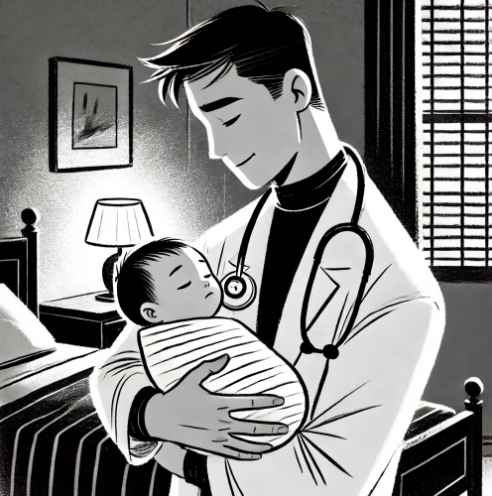
Differentiating heart murmurs was so much part of the job throughout paediatric medical residency. Each type, location and quality of a murmur, opens a list of possible differentials, possible defects to explain the abnormal heart sound. But there is one murmur that is remarkably distinct - the VSD murmur (VSD - ventricular septal defect). That familiar rumble that pans through systole, heard loudest at the lower left sternal edge of the chest. And if you’re ‘lucky’ it even comes with a palpable thrill. You just couldn’t miss it.
And that is the utterly medical introduction to this utterly personal story. In clinical communications, we’re told to avoid medical jargon like a plague. But I’ve come to terms with the fact that this story can’t help but be medical, as much as it sets out to be humane. Part of me had to process the events in the most medical of ways, in all of its jargonistic madness. I’ve always thought of myself as a ‘heart-over-mind’, ‘feeling-over-fact’ kind of doctor, or father, for that matter. But this account is well and truly about worlds colliding - science / art, medicine / humanity, doctor / father, systemic / pulmonary… coming together in an unexpected, bizarre, beautiful equilibrium.
And so that familiar rumble rang through the earpieces of my stethoscope, sending ‘VSD’ alarm bells ringing off to the recesses of my brain. But this time as I stared down at my patient, it was the sweet angelic face of my 9-day-old son. There was no one taking notes, no one on a ward round. The clinic was my bedroom. The parent to update was my wife. I looked up at Carol, with the eyes of a lost puppy showing up at the wrong doorstep. She wasn’t paying much attention - I had told her that I was just taking a casual listen to ‘clear’ that ‘innocent’ murmur that was heard in the first 24 hours of his life. I still don’t know what strange confidence possessed me into the ignorant assumption that there would be nothing pathological in my own son - perhaps his two healthy strong sisters who have always knocked their milestones out of the park? Something I clearly took for granted. Indeed, the health of children is so invaluably precious. It is a prized possession, an undeserved reward to behold. A reverence that should come naturally with the job of seeing sick children all day, but quite as easily gets lost along with it.
It may not have been the most delicate way of ‘breaking bad news’, but I simply let out an “Oh no…” and just left it hanging there. What can I say, words failed in that overwhelming moment. I found myself tangled in a messy mix of disappointment, guilt, bewilderment, sadness, disbelief… culminating in a frail, sorry “Oh no…”
The echocardiogram showed a moderate perimembranous VSD, measuring about five millimetres, two thirds the size of the aorta. Gosh that sounds a lot larger when it’s contextualised within that tiny frame of your own flesh and blood! As to the possible outcomes - I guess ‘moderate’ would be an apt way to describe it. It could go both ways, not really large enough to say it will denitely become symptomatic and require heart surgery… but also not quite small enough for that ‘most of them don’t cause problems or close spontaneously’ reassuring spiel. It’s middle-ground, murky waters, uncertain territory… none of these are places I particularly thrive in. This feels like a sauna of questions and ‘what-ifs’ to simmer in, with only time on our hands as me and my anxiety have nervous staredowns at each other.
I know… this all sounds a tad melodramatic for a VSD. And I acknowledge with all the respect in the world, that there are worse things for babies and their families to go through. Conditions far more complex, irreversible, life threatening, devastating or world-shattering… But it is this very notion that perplexes me. That compulsion to rob oneself of the freedom to feel, to traverse the range and depth of an experience and its impact on us. That knee-jerk reflex of rationality, as we put grades on suffering, and measure experiences on our self-made scales. Perhaps this is yet another job hazard. But why is there a need to justify processing, reflecting and navigating these emotions that are mine to have? This story, these words, these sentiments - they ache to find their place, they yearn to be found.
So this poem is me sharing what it feels like to be on the other side of the consultation room. It hopes to embody the tension between paediatrician and parent. To stand in awe of perfection within pathology. To recognise sadness, while relishing meaning and mercy. And if the see-saw between deficiency and wholeness is evident within its lines, it is because of the bittersweet ironies that have been haunting my heart and mind in this trying season.
But above all, it is a message to my son. Dear Colin, I know not the subsequent clinical course, but this was what I knew at the point of your diagnosis, and everything that it encapsulates. And when you are bigger, you’ll read this and you’ll know better how things turned out. And perhaps this would all be an embarrassing dad moment and a massive overreaction to a distant and resolved blip from the past. “Papa you’re such a drama queen!” I imagine you say. We’ll have a laugh about it, over coffee or wine, but deep down you’ll know: how I felt about you right then in that blip of a moment. And that the love right in front of you was all the same. It stood the test of time. And you’ll heave a sigh of relief knowing that this ‘defect’ did not, and never did, define you.
Christopher Seow is a paediatric doctor at KK Hospital, specialising in infectious diseases. He is also a proud parent of three beautiful children. While Paediatrics may not have fully prepared him for the challenges of parenthood, parenting has certainly honed his practice of Paediatrics. Having always loved telling a good story, the sleepless nights (both at home and at work) serve as a hotbed of inspiration that fuels his creative writing.
Talk back
Thoughts, reactions, a story of your own. We read every comment.