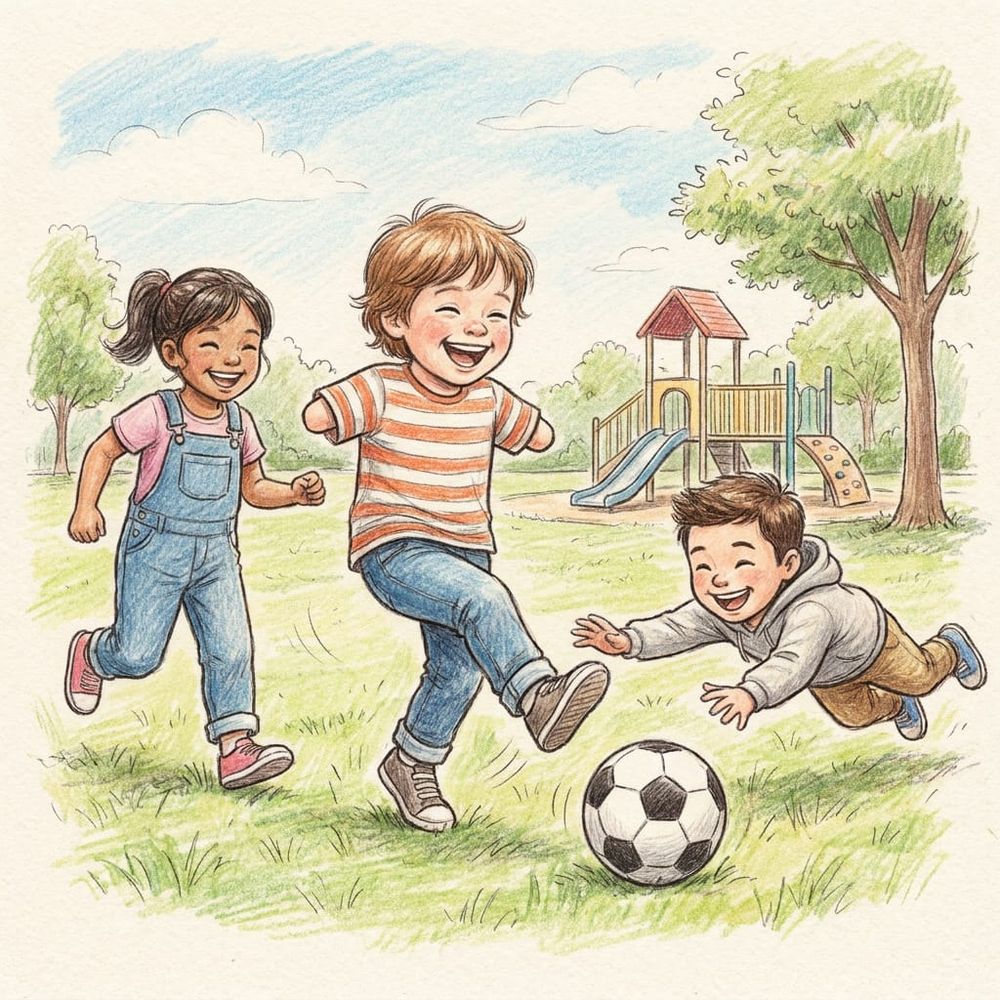
“How come you don’t have hands?” gasped Mabel as she stared at her new friend, Zoe.
I froze.
“Gosh, is this how children make friends these days?” I thought to myself.
Beside me stood Zoe, a 9-year-old double amputee, silent as she processed the weight of Mabel’s words.
Almost instinctively, I pulled Zoe away in my clumsy attempt to protect her from the sting of the comment. “Hey Mabel, be nice to your new friend,” I warned gently before bringing Zoe to the corner to continue our playtime.
But Zoe, cheerful as ever, resumed playing almost immediately — as though nothing had happened. I told myself that perhaps it was her maturity that allowed her to brush past moments like these so easily. Yet something about the interaction lingered heavily with me, as though there were loose ends left untied.
In the middle of our game, I quietly asked Zoe how Mabel’s words had made her feel. “I felt embarrassed,” she admitted softly. I asked whether people in school ever made similar comments. She shook her head. “My friends see me every day, so they’re not surprised by my condition anymore.”
At that moment, I wanted to wrap her in the warmest hug. But in just two volunteer sessions with her through my medical school’s outreach programme at Club Rainbow, I had already learnt that Zoe was not the kind of child who wanted pity. She simply wanted to be treated like everyone else.
So instead, I reassured her that there was nothing about her body she should ever feel ashamed of. If anything, she should feel proud. Proud that despite living with a rare skin disorder like harlequin ichthyosis and undergoing double amputations, she had still found a way to live so fully and joyfully in a world that could sometimes be painfully unkind.
And joyful she was.
In only two sessions, Zoe had already taught me something far more profound than many lessons I had encountered in medical school. She taught me what resilience truly looked like — not the dramatic, triumphant kind we often romanticise, but the quiet, ordinary courage of continuing to laugh, play, and exist wholeheartedly despite unimaginable hardship.
That evening, I returned home and shared this incident with my family. Midway through the story, I suddenly found myself crying uncontrollably. My mind kept replaying that moment between Zoe and Mabel.
It struck me then that for all this while, I had been telling myself that Zoe was a “normal” child and that the best thing I could do was to treat her exactly like any other 11-year-old. I never rushed to help her uncap markers. I teased her with difficult math problems. I avoided making her feel as though the absence of her hands defined what she lacked.
But that day, Zoe made me realise something important. She was not “normal.” She was extraordinary. Not because of her condition, but because she possessed a resilience and optimism that many adults spend entire lifetimes trying to cultivate.
Because, while we often tell ourselves that volunteering is about helping others, the truth is that we rarely realise how much they offer us in return. Sometimes, the people we think we are supporting are the very ones quietly teaching us how to live.
The writer is deeply grateful to the Bright Buddies program at Duke-NUS and Club Rainbow for making this opportunity possible. Established in 1992, Club Rainbow (Singapore) is a non-profit organisation dedicated to supporting children with chronic illnesses, many of whom have disabilities and special needs, and their families. Anchored in their commitment to empowering individuals to lead dignified lives and become active contributors to society, Club Rainbow delivers more than 30 critical programmes, services, and assistance schemes to support our children and their family members.
Madhu is a final-year medical student at Duke-NUS Medical School with a passion for the medical humanities. Trained in Anthropology, she uses writing to make sense of her encounters in medicine and to cultivate the empathy and thoughtfulness she hopes to bring to her future practice.
Her essay is a reminder that learning in healthcare often happens beyond the classroom—and that some of our greatest teachers come in the most unexpected forms.
Talk back
Thoughts, reactions, a story of your own. We read every comment.